Monday, August 15, 2016

A Writer's Journey Trade

One of the first blogs I ever read when I was starting in the baseball card blog world was The Writer's Journey. I know a lot of folks in the blog world started by reading and following Night Owl, but for me TWJ was the one that got me thinking about blogging. I started reading even before I got my baseball cards shipped to me from my mom's house. His posts on baseball cards made me want to get back into collecting.

And yet, after reading, I was thoroughly intimidated. He was writing about everything that I wanted to write about -- books, music, baseball cards, and television -- but he was doing much better at writing about all of them than I could dream of doing. And he was covering things like toys and movies and photos in a way that I never would. 

JT is a real writer. I mean, he's actually a published author for a short story he wrote. 

And yet, this post is the first time that I've mentioned him or traded with him at all. It's sort of funny -- intimidation, that is. It can lead us to avoid talking to or corresponding with someone for years because we feel inadequate, or know we'll be inadequate. Then, when we finally talk to that person, we are disarmed by how wonderfully pleasant and friendly they are.

This is a long way to say that JT and I talked back and forth on Twitter a bit, and he agreed to send me some cards. I need to package up my response package yet -- with various things here, it will probably be this weekend -- but it was good to realize that JT is just another good person in the blogosphere.

Since he likes music a lot, I thought I'd post some music that I've heard here live in Atlanta (or even in Athens) in my life in small bars, clubs, lounges, or little theaters to thank him for the cards he sent.


This is Ultrababyfat live from the Star Bar in February 1999. I wish I had seen this show, but I had literally just moved to Atlanta on February 15 of 1999. I caught them at Star Bar about a year later. Star Bar is in the Little Five Points area in Atlanta, and it's a damn cool bar. In 2001, I went to "Bubbapalooza" there -- a three-day rockabilly festival on that little stage (and one outside). It's just an awesome dive bar with a great lineup of bands that may never ever make it anywhere and that's not what drives them. 

Seriously, though, this place is worth a visit if you like music and you make it to Atlanta. Just expect a very diverse crowd.


Eclectic and diverse is a good way to describe the package that JT sent my way. It definitely had focus in the late 1980s and early 1990s, but it also had a bunch of other things thrown in that were full of surprises. 

Not unlike local music, to be fair. You never know what a band is going to be like...like this next band:


The Unsatisfied was another band that a buddy and I saw at Star Bar. Now that I think about it, I think they were one of the bands who opened for Ultrababyfat. The band is from Chattanooga, and I think the lead singer of this band is sort of a cross between Jim Morrison, Steven Tyler, Adam Ant, and Iggy Pop. The guy is strangely magnetic to watch, even if the sound quality here isn't all that great.


Paul Molitor doesn't really have anything to do with any of that, other than the Adam Ant part. Maybe.


This next band, The Stimulants, I think was the first band I saw literally on the same night as Ultrababyfat and the Unsatisfied. Either I was hammered and thought everyone was great, or else that night just left an impression on me. Actually, I'm pretty sure I was at least somewhat drunk because I bought CDs from all three bands. I really liked UBF. The Stimulants were next best to me. The Unsatisfied? Eh...


"Eh" pretty much describes my reaction to the deluge of "Classic" cards that started in 1987 and ended in the early 1990s. I remember the early 1990s very well, and these pastel-ish purple cards stylewise were about 5 years out of date at least at that point. Add in the "91" written in what looks to be a McDonald's font (that red and yellow together screams fast food!), and you have a really ugly baseball card.

Still, the photography is still better than the over-treated Panini stuff that shows up on those Prizm cards.


Royal Fingerbowl was a band that came out of New Orleans in the early 2000s led by the now-legendary Alex McMurray. As a live band, it featured a singer, a stand-up bass, and a sousaphone. Seriously. A couple of us saw Royal Fingerbowl play at a long-gone dive called Echo Lounge in East Atlanta. It was our group of three people joined by approximately 8 to 10 other people. 

I totally had no idea why the crowd was so small after listening to them play. Despite the music being a bit dour at times -- or, as McMurray's bio says, "most of the time" -- it's actually excellent music in my opinion.


Speaking of "a bit dour," Prince Fielder's retirement is still a bit too close in time. The one bright spot here is that the "superstar celebration" actually ended up in my Ryan Braun collection since it already appears in my Fielder collection.


Kevn Kinney is the lead singer of southern rock band Drivin' N Cryin'. I happened across a show earlier this year on PBS where DNC was inducted into the Georgia Music Hall of Fame, and it was an incredible show to watch. I've loved Drivin' N Cryin' since my freshman year of college 26 years ago. 

I've seen Kinney play shows by himself in Athens, and I even happened to run into him hanging out in Athens in a nearly empty bar during spring break in 1996. I stayed in town during that break my first year of law school, and I went out for beers with a girl from my class to watch her beloved BU Terriers hockey team on TV. Kinney was just hanging by the door acting like the doorman, but he could hardly see my ID because of poor eyesight. It was funny and sad all at once.

But the guy is a legend.


Two of those guys are legends. Mark Loretta was a good player, and maybe someday Taylor Jungmann will be a Brewer legend. Maybe. 

I do love that Rollie Fingers card, though. It's like Night Owl said yesterday about Archives in that it's kind of cool to see a card with the same design as a year the guy was on the team but with a very different card. It's like a cool variation.

One more song from Kevn Kinney: "Baseball Cards and Bicycles"


JT, thank you very much for the cards and, a couple of years ago, the inspiration to blog.

Sunday, August 14, 2016

Meet the Brewers #31: Dave Baldwin

When last we visited the 1970 Milwaukee Brewers, General Manager Marvin Milkes had started the chopping and changing of the Opening Day roster -- calling up and trading for a new middle infield. Ten days after Roberto Peña joined the team, the Brewers slipped deeper into their malaise -- running off a streak of 6 straight losses. 

Pitchers John Morris and Bob Meyer both had to be put on the disabled list on May 29. Still, that did not save George Lauzerique, who was sent to Triple-A Portland at the same time. To replace Lauzerique, the Brewers looked to a short reliever there, reliever Dave Baldwin, who was having an excellent first two months -- 27 innings with a 1.33 ERA and 28 strikeouts (with 10 unintentional walks). So, Baldwin got the call and slotted into the bullpen. He didn't stop the losing streak on May 29, but he did pitch right away and held the Tigers scoreless over two innings.

1971 Topps
David George Baldwin grew up in Tucson, Arizona. In the days before professional teams really appreciated college baseball and despite offers to sign a professional contract, Baldwin went to college and pitched in the 1959 College World Series for the University of Arizona. During his time at Arizona and as a sophomore, he suffered an injury that probably was a torn ulnar collateral ligament in his right elbow. 

Before his injury, he was your typical fireballer. He lost velocity after the injury. Still, he showed enough to get signed by the Philadelphia Phillies in 1959 at the age of 21. He bounced around the Phillies system, reaching Triple-A in 1962. But his results were bad. It looked like he had topped out as a Double-A/Triple-A pitcher by around 1964 after experiments with high-leg kicks and knuckleballs.

1971 O-Pee-Chee (back)
During the 1964 season, Baldwin found himself getting released from Single-A Durham. His manager there, Billy Goodman, told Baldwin that he should keep playing but that he had to come up with a different approach to pitching. Baldwin did exactly that -- becoming a submarine pitcher in an era where that was viewed negatively. 

WIthin two years, Baldwin found himself in the major leagues as a submariner, making his debut at the age of 28 for the Washington Senators. In 1967, in fact, he finished seventh in the American League in saves with 12 in a season in which he appeared 58 times (68-2/3 innings) with a 1.70 ERA and 52 strikeouts. In other words, being a submariner worked.

Baldwin stayed with Washington until after the 1969 season. The Senators traded Baldwin to the Pilots for thirty-five-year-old George Brunet after Baldwin had put up back-to-back seasons with ERAs of over 4.00.  

1971 Dell Today's Team Stamp
Baldwin pitched pretty well for the Brewers -- though his 2.55 ERA masked a FIP of 4.17 thanks to some luck on BABIP (.228). Baldwin missed some time during the season due to a sprained right ankle suffered against the Boston Red Sox. 

Despite the fine season in the previous year, Baldwin was not assured of a roster spot in 1971. That became clear halfway through spring training when new GM Frank Lane decided that the team did not need Baldwin any more and sold his contract to the San Diego Padres Triple-A affiliate in Hawaii. Baldwin kept plugging away, though. He never made it to the majors with San Diego, but he did get one last call-up to the White Sox in 1973 for a 32-game stint. He stuck it out for one more year in the minors at the age of 36 before retiring from baseball.

1994 Miller Brewing Commemorative Set
In retirement from baseball, Baldwin continued to reinvent himself. He went back to the University of Arizona after retirement and finished his Masters of Science in Systems Engineering and, then, his Ph.D. in genetics. As was once written about Baldwin in the May 2000 issue of Scientific American, he is "surely the only person to publish in the Proceedings of the Entomological Society of Washington and to pitch for that town's team."

He's an acclaimed poet (under the pen name of DGB Featherkile), and his humorous poems are available in book form from Amazon in a book called Limbic Hurly-Burly: Poems of Humor and Paradox. His memoir about his life is called Snake Jazz and is available directly from the author through his website, www.snakejazz.com.  He's also a painter/artist, and his painting "Fugue for the Pepper Players" is in the Baseball Hall of Fame Museum.

"Fugue for the Pepper Players"
These days, Baldwin describes himself as a contented retiree. He still speaks from time to time, and he is a member of the Society for American Baseball Research (SABR). As all of this shows, Baldwin is a true Renaissance man.

As far as baseball cards of him on the Milwaukee Brewers go, Trading Card Database shows four total cards of him as a Brewer. As you can see above, this appears to be the first time that I can say that I have literally every card of one of the Brewers I'm profiling. I'm pretty sure that that will not happen often.

Saturday, August 13, 2016

An Uneasy Peace Evaporates: Will Bob Walk Again?

All wars start small. They all do. Sometimes it is just a minor misstep, a small infraction, that leads to a cataclysmic disturbance. 

For instance, while in retrospect it is easy to see, very few people in 1914 recognized immediately that one assassination would reshape Europe. Indeed, the actions of a small group of assassins whose plans to assassinate Archduke Franz Ferdinand were carried out by a 19-year-old named Gavrilo Princip, and it led in just over a month to a complete disintegration of Europe as those people knew it. 

The archduke's assassination led to Austria-Hungary declaring war on Serbia. The Austria-Hungarian empire used the opportunity to try to take over all of the Balkans. Russia had a treaty with Serbia, so Russia came to Serbia's defense. Austria-Hungary's alliance with Germany was therefore invoked, causing Germany to declare war on Russia. That declaration of war led France and Great Britain to get involved -- all through what the New York Times called "a web of previously established alliances."

The situation spiraled very suddenly and very quickly out of control, and in just over a month, the Central Powers of Germany and Austria-Hungary were squaring off against the Allied Forces of France, Great Britain, Russia, and eventually the United States. 

Like all depressing or cataclysmic events, World War I led to incredible literature and movies being made. German war veteran Erich Maria Remarque wrote All Quiet on the Western Front -- a book quickly adapted into the Academy Award winning movie of the same name:


Sadly, the movie and the book appeared in the midst of the churning storm that Europe remained -- an uneasy peace. Great divisions appeared. Russia turned on itself, with the Bolsheviks overthrowing the government and forming the USSR. Germany suffered from economic problems starting early in the 1920s thanks to the oppressive terms for reparations imposed on it by the Allied Powers. Soon thereafter, the Great Depression worldwide piled on to make matters even worse.

The German people blamed outside influences for their troubles. It too crumbled internally and turned on itself, as did Spain -- leading to the rise of fascism there under Generalissimo Francisco Franco. Adolf Hitler rose to power, and the peace got even uneasier. Hitler came to power through his speeches and his charisma and his Brownshirts. Major changes came as Hitler consolidated his power and, eventually, decided his German people needed more "lebensraum" -- living space.


Since World War II, we have avoided wars that involve everyone. Perhaps it's the whole "mutually assured destruction" thing that nuclear weapons provide. Still, minor wars break out regularly around the world. One broke out in 1969 thanks to El Salvador beating Honduras in a World Cup qualifying match.

No, really.


Many wars lead to bloodshed, but some don't. The Cold War had skirmishes around the world that led to death and bloodshed, but the US and USSR rarely engaged one another directly. 

Economic "wars" almost never lead to bloodshed, but they do lead to higher prices and lost jobs, often. One trade war broke out in the 1960s between the United States on one side and West Germany and France on the other. It was called the "Chicken War" because the European countries were trying to protect their own chicken farmers from cheap American chicken. In response, the US raised tariffs on light trucks -- a tariff which has basically kept foreign automakers out of the US market for light trucks because of cost to the consumer.

It also led to some really ugly-ass cars coming into the US from Japan:


Here in the world of baseball card blogs, we've had a few wars ourselves. There were the wars between Topps, Donruss, Fleer, Score, Upper Deck, Pacific, etc. in the 1990s over who could issue the most garish baseball cards, for example (by the way, I think Fleer 1995 won).


God that's terrible.

Those wars became wars of attrition. Companies fell by the wayside in the wake of the 1994-1995 strike one by one. A number of the wounds were self-inflicted -- I mean, did we really need 202 different insert types and 9 parallels in the 2005 Donruss Diamond Kings set? They might be great cards, but if you make that many damn inserts and parallels, you only inspire loathing.

We have also had trade wars here. The great Jaybarkerfan and I engaged in a multi-box, multi-post, multi-bipping masterpiece of a war that caused my collection to expand exponentially, added a Warren Spahn autographed baseball to my PC, and led to a Canadian invasion of Northern Alabama. At that point, we declared a truce.

My war with JBF was but a minor skirmish, though, compared to the all-out double nuclear armageddon engaged in between the two superpowers -- JBF and Bob Walk the Plank. It started innocently enough -- with Wes reaching out to Matt saying that he had some Pirates to send to Morgantown. It didn't take long -- just 6 months -- for all-out war to be declared.

Just three months later, Matt admitted defeat. JBF buried him with game-used jerseys, autographed bats, a canceled check signed by Ralph Kiner, and a special commemorative PSA Authenticated Jack Ham autographed jersey.

But, y'all know Matt. He can't leave well enough alone. 


The next thing you know, you start hearing rumblings. "He sent you what? An autographed bat? From whom? No WAY!"

Pretty soon, you end up writing a long post about the origins of wars and about chicken taxes.

You see, an email popped up in my inbox this morning. It was from Jaybarkerfan, which gives me an excuse to show another photo of the Real Mrs. Jay Barker:


Sometimes the ugliness of war has to be counteracted by beauty.

Anyway, Wes's message was short:

You tell Bob Walk the Plank that I'm coming, and hell's coming with me!


This is gonna get ugly, y'all. But I bet it will be fun to watch!


Thursday, August 11, 2016

Mail from Ketchupman36

I'm always on the lookout for new blogs. I remember how long it seemed to take for my blog to get any traction with other bloggers. Some of those earliest posts barely reached double digits in hits -- like the 10 hits for my post highlighting my TTM from the early 1980s of the then-league presidents, Lee MacPhail and Chub Feeney, for example.  A few didn't even get that -- like the paltry five hits for the first and last of what was going to be a series called
Sunday's Strange Set from the 1980s.


Like I said, I know how it feels when you write something and it seems the only person who reads it is you -- and you get five hits because you forget to turn off that setting where your views count as hits and you reloaded the page 4 times hoping for a comment. 

Of course, I am throwing stones in a glass house because, well, I comment on posts approximately 5% of the time when I read them. Sorry.

At any rate, a new blog popped up in May called "Rekindling the Cardboard Flame." Operating under the nom de plume of Ketchupman36 and the nom de Twitter of The Cardboard Flame (so, let me call him TCF), RTCF is a well-written blog that appears about 8 or 9 times a month. 

A name like that deserves a song:


Um, yeah, I must have missed that song when it came out in 2002, but "Las Ketchup" are a pretty hot group of women in that "Spanglish" version. I guess "Las Ketchup" is the Spanish version of "Spice Girls." I guess it's cool that they are from Córdoba in Spain; I spent nearly 2 hours there one day on my honeymoon, so that makes them practically my cousins.

Anyway, back on point...I've exchanged messages on Twitter with TCF a few times. When I heard that he had an inkling of possibly maybe liking basketball cards, I quickly duped, er, offered to send him all the basketball cards I had -- maybe 150 or so, more or less. He told me sure, he'd take them off my hands.

In return, I got two great cards. Trust me -- I'm more than happy with my end of that bargain.


The first card I got was this very nice Robin Yount Insert from this year's Stadium Club -- the "Legends Die Cut" insert. As with nearly every recently issued product, I tend to shy away from buying unopened boxes of cards due to the fact that the Brewers end up with like 5 cards out of 700 in a set. I guess with this one, though, I should have been in the Club for it.


For some reason, this song has been stuck in my head for a couple of days now thanks to a Sporcle quiz that included the word, "Hug" in it. My brain works in ways I can't explain.

The other card that I got from TCF was even more inspiring:


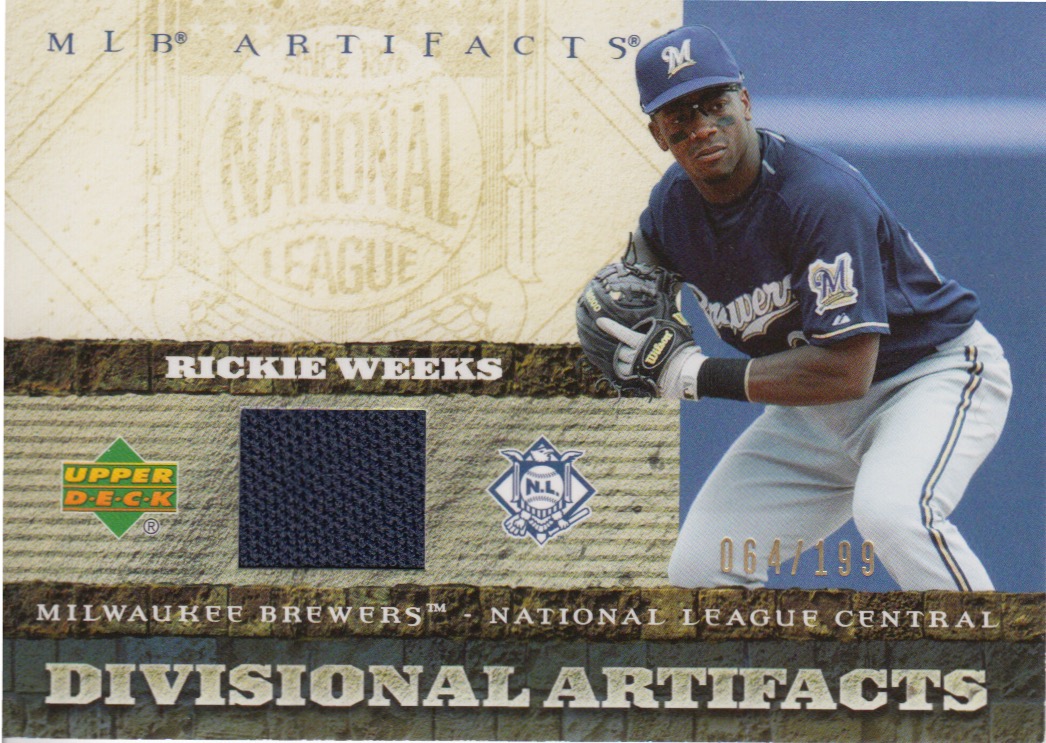
From the 2007 MLB Artifacts comes this Rickie Weeks "Divisional Artifacts" relic with a serial number of 64 out of 199. In many respects, it's been good seeing Rickie Weeks continuing to hang on as a utility player in Arizona. Sure, he's had an almost league average season this year (OPS+ of 98) in 155 plate appearances, but by all indications he's fit in his role fairly well after last year's nightmare in Seattle.

Let's close with a little bit more rap -- Rickie's walk-up music this year in Arizona. Rickie is surrounded by a ton of very questionable song choices by his teammates, with Luke Bryan (Andrew Chafin), Florida Georgia Line (Chris Owings & Shelby Miller), Brantley Gilbert (Jake Barrett), Randy Houser (Paul Goldschmidt), and Eric Church (Phil Gosselin) all making games in Phoenix sound like a dried-out Nashville bar. Thankfully, Rickie has stuck to his guns and uses Lecrae:


Many thanks go out to the Ketchupman a/k/a The Cardboard Flame for these two great cards. I hope this is the first trade of many more.

Wednesday, August 10, 2016

Goodbye, Prince

One of the first theories about projecting young baseball players that I can remember was Bill James's description of "Old Player Skills." This referred to players who displayed skills such as relying on power and high walk rates with less speed and a lower batting average. As this FanGraphs article mentions, Nate Silver performed a study that showed that guys with "old player skills" early in their career -- which he defined as being age 25, having a top-quartile walk rate, a bottom quartile speed score, a top half isolated power, and a bottom half batting average -- tended to peak and decline earlier than the average player.

That FanGraphs article, written in February of 2011, tried to identify players who might fall victim to that "old player skills" curse. The three players that article identified? Brian McCann, Ike Davis, and Prince Fielder. 

Here we are, five years later. McCann has played in 90 games this year with a slash line of .231/.329/.410 -- which is basically how he has performed for his entire Yankees career. Davis -- who was just 23 at the time of the article -- was released today at the age of 29 by the Yankees. And, then, we have Prince.


Prince burst onto the scene in 2006 when he hit 28 HR, drove in 81, and hit .271/.347/.483. Starting in 2006 and ending in 2013, Fielder played nearly every game -- sitting out a game in 2010 thanks to the flu after having an IV administered by the Astros team doctor. Even then, after getting the IV done, he tried to get into the lineup. He missed one game between 2008 and 2013 out of a total of 912.


He was a force of nature for the Brewers. In slightly over 6 seasons, he hit 230 home runs in just 4210 plate appearances. When he left the Brewers for free agency, he was second in team history to Robin Yount in HRs (both have since been passed by Ryan Braun). He holds the top 2 spots and is tied for 9th in home runs in a single season in Brewers history. He is the only Brewer to ever hit 50 HR in a season (2007) and added 46 in 2009 and 38 in 2011.


He also holds the team single-season record for RBI, having driven in 141 runs in 2009. For good measure, he also holds down spots 9 and 10 on that list. Showing evidence of his "Old Player Skills," he is the only player in Brewers history to have been walked more than 100 times in a single season -- and he did that three times as well from 2009 to 2011. Indeed, in that category, the only players in Brewers history with more walks are Paul Molitor (755 BB in 8438 plate appearances) and Robin Yount (966 BB in 12,249). Fielder walked 566 times in just 4210 plate appearances.


Yes, I have two different bat swatches from Fielder from 2010.


While Fielder was with the Brewers, the team was a contender. From 2007 to 2011, the Brewers finished under .500 twice (both under the mistake called Ken Macha in 2009 and 2010, thereby wasting Fielder and Braun). Bookending the Macha-stake were two seasons in which the Brewers went to the playoffs -- 2008 (in which the Brewers lost to Philadelphia in the NLDS 3-1) and 2011 (in which the Brewers lost to the GD Cardinals 4-2). 

The club had a winning record in 2012 and 2014, but the window on contending with that core of players -- the group of Braun, Fielder, Gomez, Lucroy, Gallardo, and Weeks -- really closed when the first of the bunch left for greener pastures in Detroit. Fielder signed a massive 9-year, $214 million contract with his dad's former team. Fielder's agent, Scott Boras, made clear to the Brewers that Prince was looking for a contract in excess of $200 million, and Mark Attanasio and Doug Melvin wisely, though sadly, had to pass.


Fielder played every game in his two seasons in Detroit, but his numbers started fading in 2013 already at the age of 29. After that season, the Tigers flipped him to the Rangers along with a satchel containing $30 million (or at least that's how I picture it) in exchange for Ian Kinsler. At the time, Jonah Keri thought it was a good deal for both teams. Oddly, he fretted about Kinsler being a second baseman and pointed to Nate Silver's study about ugly, rapid declines for second basemen with nary a mention of Fielder's old guy skills. Indeed, he actually shrugged off FIelder's increasing strikeouts and decreasing walks and home runs. For what it's worth, Kinsler is still playing at a high level for the Tigers at the age of 34. I guess that proves that smart guys like Jonah aren't always right.


I'm thinking I have a lot of Fielder fabric swatches because, well, his shirts were so large.


Seriously.


The Brewers have yet to replace Fielder at first base completely. Chris Carter hasn't been terrible, and Corey Hart did pretty well in 2012 there, but from 2013 through 2015 the position has been an utter disaster -- I mean, Yuniesky Betancourt actually played more games there than anyone else in 2013 (1 more than Juan Francisco); 2014 featured the artistic strikeout stylings of Mark Reynolds couple with Lyle "O for 4" Overbay. 2015 saw Adam Lind take the spot, but the minute that the team did not contend immediately last year was the minute that Lind would be out the door (and he was).


All of those players -- okay, other than the 2013 tandem of Betancisco -- were/are decent players to be fair. But none of them are stars. Prince was a star.


The Rangers had to hustle to make up for his loss in the order. Despite his Indian Summer last year -- hitting .305/.378/.463 with 23 homers -- it's tough to count on someone to be a key bat in your lineup for many years after they have undergone spinal fusion surgery.


Watching Prince's retirement announcement today was very difficult. He was fully in tears immediately, spoke haltingly, and had a neck brace on after his second surgery.


As he said in his speech today, he's been around major league ballparks since he was a little kid thanks to his dad being Cecil Fielder. Yes, there is an appropriate symmetry that the two would both finish their careers with 319 HR, though Prince was definitely the better hitter overall thanks to his higher batting average and walk rate (daddy never walked more than 90 times and even led the AL in strikeouts with 182 in 1990 -- the same year he hit 51 homers).
Of course, a post about Prince would not be complete with one of the best-ever Milwaukee Brewers baseball cards: his 2010 Topps flagship card.


That came after a walk-off homer for Prince against the San Francisco Giants in September of 2009:


Prince was a great player for too short of a time. Though we could always see the swift decline coming, it doesn't make the fall to the end any softer.

Sunday, August 7, 2016

Bowman Sorting

I decided to take a week off from blogging this week to try to get my Bowman team sets and assorted parallels and inserts organized. I'm getting closer on that process -- I mean, I've finally got what I consider to be good want lists put together for all of the base sets from 1989 to 2007 (which is what fit into the new binders I've employed) and, then, from 2008 to the present.  

I think it should be pretty obvious as to why I'm working on Bowman right now. Bowman is the prospector's set -- particularly the Draft Picks and Prospects set since its debut. Since I've gotten only a few cards into my collection recently, I thought I'd take my opportunity instead to look at past Brewers prospects to hit the Baseball America Top 100 Prospects

BA started its ranking back in 1990, so we have 26 years to work with. And, since I enjoy cautionary tales as much as I enjoy success stories, let's focus on the overhyped and overrated. Let me tell you -- there are plenty of those.

Narciso Elvira
That's Elvira's 1991 Bowman card, of course.  

Of course, for those of us old enough to remember the early 1980s, the name "Elvira" really brings to mind only one thing:


Brewer fans' hearts were on fire for Narciso Elvira in 1990 and 1991. On BA's inaugural Top 100 Prospects list, Elvira was the #23 overall prospect in all of baseball in 1990. He dominated at lower levels -- averaging over 10.6 K/9 over 251 innings over two seasons in the California League at the ages of 20 and 21 in 1988 and 1989. 

Unfortunately for Elvira, his pitches must have looked like cherry wine after that. Two issues were going on here. First, the Brewers Double-A and Triple-A outposts at that point were a gauntlet for pitchers -- Double-A El Paso, Triple-A Denver. I mean, how about just take a sledgehammer to their arms instead? At least that pain goes away quickly rather than lasting six to eight months.

The second issue is that Elvira was small (5'10" tall) and plagued by shoulder trouble. This being the Brewers under Sal Bando, that meant that minor league coordinator Bruce Manno spoke of Elvira in almost disparaging terms: "You're only a prospect so long and then you become a suspect. He has to establish what kind of pitcher he's going to be." 

He did: it was a Mexican leaguer. Elvira pitched only 5 total major league innings, walking 5 and giving up 6 hits and three earned runs in 1990 while striking out 6. The Brewers let Elvira go after 1991, and Elvira's career wandered from Triple-A to doing nothing for the years between 1992 and 1996, then back to Triple-A in 1996 and 1997 to the sidelines again then to Japan in 2000 to Mexico and Korea in 2002 and 2003, back to the sidelines in 2004, and back to the mound in 2005 and 2006 in Mexico, then 2007 and 2008 off before getting into 2 games in 2009 in Mexico at the age of 41. He even pitched a no-hitter in Japan on June 20, 2000 for Kintetsu. Here's the 9th inning of that game:


Antone Williamson


Antone Williamson was another multiple year Top 100 prospect according to Baseball America, showing up at #64 in 1995 (the Brewers' only representative on the list that year) and at #81 in 1996. The Brewers drafted WIlliamson in the first round of the 1994 draft, taking him with the fourth overall pick that year.  Playing the "what-if" game, the Brewers could have selected Paul Konerko,, Jason Varitek, Nomar Garciaparra, A.J. Pierzynski, Aaron Boone, Javier Vazquez, Troy Glaus, or Jay Payton, among others, with that pick. It wasn't a great draft, to be fair, with Garciaparra enjoying the most career WAR in that draft at 44.2. For comparison's sake and through August 6's games, Mike Trout has 45.9 career WAR according to Baseball Reference.


The Brewers were very excited by the pick. Stories in The Milwaukee Journal hyped the pick. Williamson's own quote in the story, however, wraps up why Sal Bando was an unmitigated disaster (for the most part) in terms of making draft picks: "They drafted me because they needed a corner man."

See, that's a mistake. Draft the best player available. Draft the one who projects well, has upside, has tools, has ability, is the best baseball player available at the time you pick. Don't pick a guy because you "need a corner man" -- especially because those guys are on the right side of the defensive spectrum (left is hard side, right is easy side) and can be developed by moving a shortstop with a bat over.

Williamson failed not because he couldn't hit, to be fair. He failed because of injuries. Specifically, in 1996, he was playing in a spring training game and dove for a ball. He hurt his left shoulder badly enough that it hurt to swing. This was after having a history of problems with his right shoulder.

He returned, eventually, to make the major leagues in 1997 at the age of 23, but he hit just .204/.254/.259 -- pitifully bad stats in the age of the steroid freaks like McGwire and Bonds and Sosa -- over the course of 60 plate appearances. The Brewers gave up on him after the 1999 season. No other takers stepped up, so he played a season in the Texas-Louisiana League and "slugged" .303 in 182 plate appearances. That's where his trail ends.


To be fair, most of the guys who appeared in BA's Top 100 as Brewers prospects at least made the major leagues and, in fact, even went on to have pretty good careers. For example, the Brewers had 6 guys in the top 100 in 2004: #84 Mike Jones (a pitcher who did not make it past Triple-A), #69 Manny Parra (who pitched around the fringes of baseball through last year), #48 Brad Nelson (who also did not do much), #19 J.J. Hardy, #10 Prince Fielder, and #5 Rickie Weeks.

After the recent trades, though, if only 3 players turn out to have good careers as those guys in 2004 did, it would actually be disappointing. After all, 2016's crop includes #8 Orlando Arcia, #16 Lewis Brinson, #49 Trent Clark, #57 Brett Phillips, and #59 Jorge Lopez (who has been godawful terrible this year) -- and that does not include the changes in the ratings thanks to results this year which pushed Josh Hader up in the rankings and the drafting of Corey Ray. And that doesn't even include guys working their way back from injury like Nathan Kirby.


Farm systems are a place for eternal hope and optimism. But, for the first time in a long time, that optimism might actually be more than wishcasting. Bowman is the place for that optimism.

Monday, August 1, 2016

Watching Another PC Guy Get Traded

Last year, the Brewers were very disappointing right out of the box. That wasn't the plan for 2015; the team was trying to compete. When things did not shake out well, the club started trading pieces away -- first Aramis Ramirez (for Yhonathan Barrios, who, unfortunately, will miss this year due to a shoulder injury), and then one of my current-player PCs, Carlos Gomez.

In the offseason that followed, David Stearns -- who, I am reminded, was three years away from being born when the Brewers went to the World Series -- started trading off everything and anything he could. Jean Segura was one of the casualties, and his trade out of Milwaukee led me to discontinue his PC. It felt like a personal failure.

Today's trades, though, were much more inevitable. 


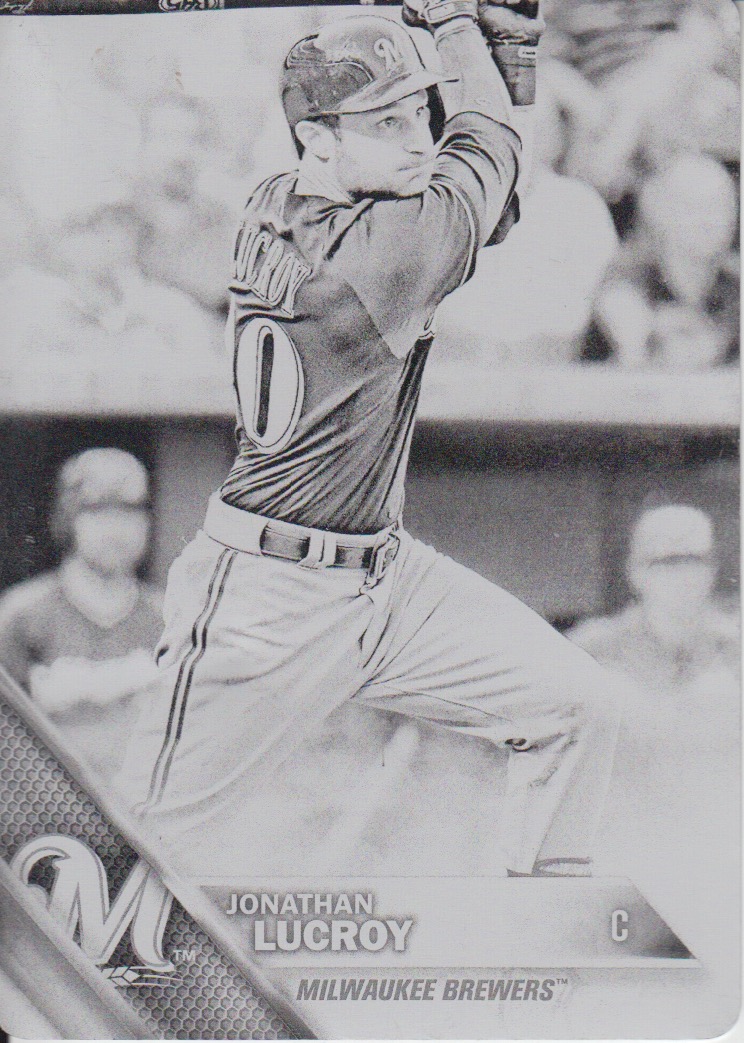
Lucroy received his current contract on the heels of his 2010 rookie season, signing a five-year, $11 million extension with a $5.25 million club option for 2017 before the 2011 season. Lucroy had hit well at every stop on his way up to the major leagues, except for his short 21-game stay in Triple-A in 2010. The team wanted to build around the young catcher.


Lucroy liked Milwaukee too. While he was born and raised in the Orlando area, Lucroy went to college at Louisiana-Lafayette and really felt at home with the smaller-city feel. After the 2014 season, Lucroy's agent approached the team to try to work out a new contract extension -- a deal that would have made him a Brewer "for the rest of (his) career." Rather than jump at the opportunity to sign the 28-year-old to a second extension, however, the team instead was lukewarm at best about the idea.


Early in the 2015 season, the Brewers looked almost prescient. Lucroy started off terribly -- 6 hits in his first 51 plate appearances -- and then he hit the DL after he took a ball off his foot and broke his toe. As things fell apart for him hitting-wise last year thanks to injuries and, then, the team fell apart, he starting expressing his displeasure with the situation.


In 2015, he appeared on a Milwaukee radio show and criticized the organization greatly for its failure to make impact picks in the first round of drafts since 2005. In fairness, he had a point -- starting in 2005 (Ryan Braun), the team's first round picks either were traded away -- Matt LaPorta, Jake Odorizzi, and Brett Lawrie -- or made little to no impact in the major leagues. Indeed, only two more players of the 19 the team had selected in the first round to that point (Jeremy Jeffress and Taylor Jungmann) have made the major leagues.


Lucroy also made another good point: he just wanted to play for a winning team, whether in Milwaukee or elsewhere. Over this past winter -- after it was made clear as to the team's direction -- Lucroy again did not demand a trade but he made his position clear: "I want to win and I don't see us winning in the foreseeable future. I want to go to a World Series. That's what all players want. Rebuilding is not a lot of fun for any veteran guy."


David Stearns held out for a lot. He viewed Lucroy as one of his top trade chits -- rightfully so with his contract being what it is. In the end, the haul for Lucroy was good and the machinations of having made a trade with Cleveland, having Lucroy veto it, and then turning around and making another trade in a package with a pitcher with a Texas-based team sounds a lot like the PC guy who headed out of town in July of 2015.


In return for Lucroy and Jeremy Jeffress from Texas, the Brewers will be getting a player to be named later -- an intriguing fact since PTBNL might very well mean "guy drafted in 2016." We'll see, but that player will likely be icing on the cake. The main player the Brewers received was #21 overall prospect (according to MLB Pipeline) Lewis Brinson. Brinson is 22 and has been working on his batting eye and approach. He is a speed-power prospect -- a legitimate 30/30 threat -- and he is learning how to play centerfield. 

The other prospect the Brewers received from the Rangers was pitcher Luis Ortiz. He's on the DL right now with a strained groin, but he's a 20-year-old in Double-A. He can use the time off. MLB Pipeline ranks him the #63 prospect overall and says that he has the stuff already to profile as a possible #2 starter (with the usual asterisk regarding staying healthy).

The Brewers also traded the Fresh Prince, Will Smith, to the Giants just days after hundreds of Brewers fans bought 90s throwback Will Smith shirts. As a result of that trade, the Brewers picked up yet another top #100 prospect -- Giants 2015 First Round pick Phil Bickford. Bickford was drafted in the first round twice -- first by Toronto in 2013 out of high school and then in 2015 by the Giants. The report on Bickford is that he has electric stuff -- 98 MPH fastball in particular -- but that he has trouble with repeating his arm slot and can lapse into overthrowing.

In the end, as much as I could hope against hope that the Brewers would take a right turn and announce a contract extension, I know that this is the right move for the team. Lucroy deserves the opportunity to win and to go to a team in a location that he had approved contractually through his limited no-trade clause. 

I'll keep collecting Lucroy's cards from his time with the Brewers as a player collection, just as I did for Carlos Gomez and Yovani Gallardo and Rickie Weeks. I hope, though, that Lucroy wins and wins a lot now.

And who knows -- maybe David Stearns can find a taker for that last guy on the team that is an active PC for me? Perhaps the Marlins will come calling for a hometown guy with a longer contract that looks decent right now so that they can plug him in at first base. All we need is, say, Braxton Garrett. I mean -- isn't that a win-win for everyone?

I think it would be.