Showing posts with label Baseball Family. Show all posts

Sunday, June 26, 2016

Meet the Brewers #28: Hank Allen

As the 1970 season progressed, GM Marvin Milkes turned the team over and over and over again. It is unclear if Milkes was instructed to eliminate virtually any reference to the Brewers' past as the Seattle Pilots, if he thought he was improving the team, or if he mistook activity for improvement. From the contemporaneous stories from The Sporting News (which I now have available due to reactivating my membership in SABR), Milkes probably thought he was improving things but the reality is closer to the latter of those three.

One of the men who cycled through Milwaukee in those activity-filled days of May in 1970 joined the team thanks to a trade on May 10. The Ted Williams-managed Washington Senators were in Milwaukee for a three game series played in two days over the weekend of May 9 and 10. The Senators lost all three games in walk-off fashion. 

Midway through the second game of the Sunday doubleheader, the Brewers traded outfielder Wayne Comer to the Senators for infielder Ron Theobald and Brewer #28, Hank Allen. Comer was informed of the trade when he came back to the clubhouse during that second game and found his locker -- except for his street clothes -- had been cleaned out. He later went into the game for Milwaukee and grounded out before joining his new Washington Senator teammates. 


1994 Miller Brewing Milwaukee Brewers
Harold Andrew Allen was born in Wampum, Pennsylvania, on July 23, 1940. Allen was one of nine children and was the oldest of the three Allen brothers who played major league baseball. Of the three, Hank was the second-most well-known by far after his younger brother, 1964 Rookie of the Year and 1972 AL MVP Dick/Richie Allen. The youngest of the three -- Ron Allen -- was the least accomplished, receiving only 14 plate appearances as a St. Louis Cardinal in 1972. Ron's only hit in the majors, though, was a home run!

Both Dick and Hank started their careers at Elmira in 1960 in the Phillies organization. The Phillies in the 1960s were not known as a racially progressive organization, and it took being a superstar to get noticed. Thus, Dick moved up quickly and made the major leagues at the age of 21 in 1963. Hank, on the other hand, was not quite as good as Dick and moved up more slowly. Indeed, it took having his contract purchased from Philadelphia by the Washington Senators for him to make the big leagues.

Hank was never a great hitter in the major leagues, but he was good enough to hang around the fringes of the majors from 1966 through 1973 (with a year off in 1971 in which he only played 13 games in Triple A in the Atlanta Braves system before being released). He hit .241/.281/.312 in the major leagues in 938 plate appearances with just 6 homers.

In 1970, he lasted for just over a month as a Milwaukee Brewer prior to being sent to the minor leagues. In that month, he got 14 starts and hit .246/.317/.316. For reasons that are not clear to me, Allen was sent to Triple-A Rochester in the Orioles system in 1970 -- was he on loan? He went to Rochester apparently as part of the Brewers' trade with the O's to receive Dave May, but he was not a part of the trade. Weird. He got a September call-up from Milwaukee, but then was traded to the Braves.

After the 1971 year off, Hank signed in September of 1972 with the Chicago White Sox. Perhaps the Sox made that move to placate their MVP Dick Allen. Hank retired after the 1973 season.

Since his retirement, Hank has had two different lives. For part of the early 2000s, he served as a scout for the Milwaukee Brewers and, later, for the Houston Astros. However, he has had a more high profile -- and perhaps unexpected -- career in another field: thoroughbred training. 

Brother Dick owned some horses while both were in Chicago, so Hank went to Arlington Park to check them out after his brother prodded him to do so. Intrigued, Hank met the then-ninety-plus year-old African-American trainer Nathan Cantrell and asked him to teach him his trade. Hank made brother Ron his stable foreman, and then turned horses into the way he made his living -- and did extremely well. Indeed, in 1989, Hank became the first black trainer since 1911 to saddle a horse in the Kentucky Derby when his horse Northern Wolf finished sixth behind winner Sunday Silence. 

After getting back in baseball for a little while after a bad 1998 (0 wins in 10 starts), though, Hank went back to the horses earlier this decade. In 2013, he trained a horse called Blessed Soul and entered her into a few races at Laurel Park in Maryland.

Apropos of that, here's a video of Blessed Soul training:


Thanks to his very short career with the Brewers, and as best I can tell, that 1994 Miller Brewing Commemorative card above is the only card of Hank Allen as a Milwaukee Brewer. No matter -- his story in horse racing is far more interesting!

Sunday, May 22, 2016

Meet the Brewers #25: Phil Roof

When the Brewers began the 1970 season, manager Dave Bristol seemingly had decided that veteran catcher Jerry McNertney would be his regular catcher. McNertney had been the starter in Seattle the year before, so perhaps there was a bit of incumbency bias going on there. As a result, it took Phil Roof until the sixth game of the season to get into a game -- and then only because the Brewers and White Sox played a doubleheader, with Roof starting game 2 of the doubleheader.

1970 McDonald's Milwaukee Brewers
By the end of the season, however, Roof had played parts of 107 games behind the plate and McNertney had played in 95 as the backstop. It wasn't a platoon -- both bat right-handed. The two men were the only players to appear at catcher that year for the Brewers, making catcher a strange island of stability (along with shortstop) when compared to rightfield (12 different players appeared), leftfield (11), and first base (10, including both catchers).

The back of Roof's 1971 O-Pee-Chee Card
Phillip Anthony Roof was born in Paducah, Kentucky in a baseball-playing family. His cousin Eddie Haas appeared in 55 total games in the big leagues in the late 1950s and in 1960, and his brother Gene Roof made 48 total appearances in the 1980s (mostly for the Cardinals but also 8 games with the Expos in 1983). Additionally, Roof brothers Adrian, Paul, and David all played minor league ball as did Gene's sons Shawn, Eric, and Jonathan.

By far the most prolific of the family, Phil played in 15 total major league seasons. Roof has a number of strange distinctions. He is one of just three players to appear for both the Milwaukee Braves and Milwaukee Brewers (2 games for the Braves, 1 in 1961 and one in 1964). The other two are Felipe Alou (who hit three times for the Brewers in 1974) and Hank Aaron. A fourth player, George Brunet, appeared for the Milwaukee Braves and the Seattle Pilots, but he never made it to Milwaukee.

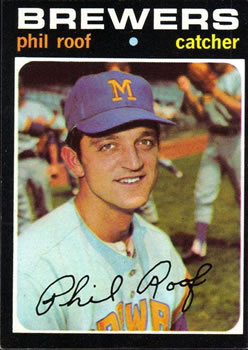
1971 Topps (or 1971 O-Pee-Chee, your choice)
Roof also appeared for the first iteration of the California Angels in 1965 after their name change from being the LA Angels. He was a member of the first Oakland A's team after their move from Kansas City. He stayed two seasons in Oakland before he was traded. Phil joined the Brewers organization while it was nominally still the Pilots, coming to the Brewers with Mike Hershberger, Lew Krausse, and Ken Sanders from Oakland in exchange for Ron Clark and Jaybarkerfan idol Don Mincher in a January 1970 trade.

Finally, he also made 5 plate appearances in his final season as a member of the inaugural Toronto Blue Jays. Amidst all those interesting places, he spent the most time with the Minnesota Twins -- parts of 6 seasons, starting in 1971 and ending 1976. Through it all, however, Roof was definitely more of a member of the backup catchers' and defensive specialists' union than any kind of star.

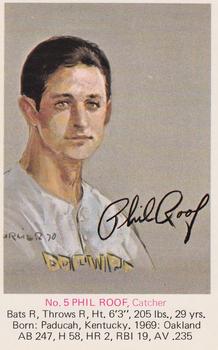
1970 Flavor-Est Milk (Reprint)

After his retirement as an active player, he spent eight seasons as a major league coach with the San Diego Padres, Seattle Mariners, and Chicago Cubs. Then, the Twins came calling and asked him to serve as a minor-league manager. He did that for 16 years before retiring in 2005. Finally, he pinch-hit as the bullpen coach for the Twins in 2011 while regular bullpen coach Rick Stelmaszek recovered from eye surgery.

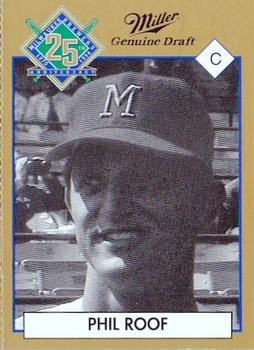
1994 Miller Brewing Set
As recently as 2013 (that's as recent as I can find), the then-72-year-old Roof still was coming to Twins spring training and throwing batting practice. In various interviews with Roof -- whether in 2000 when he managed the Triple-A Salt Lake Buzz, in 2011 when talking about his pal Bert Blyleven's induction into the Hall of Fame, or later that same year when Roof himself was inducted into the Kentucky Athletic Hall of Fame -- he comes across as someone who understands how lucky he has been to be able to spend his entire life in and around a game he's loved since he was a kid.

Counting the "milk" set, Roof appears on a total of 9 cards as a Milwaukee Brewer (10 if you count the original Milk set and the reprint separately). Of those, I have the five I've shown here. I'm missing the 1970 Mike Andersen Postcard, the 1970 and 1971 Brewers Picture Packs, the original Milk set card, and the 1971 Dell Today's Team Stamp.


Sunday, February 28, 2016

Meet the Brewers #20: John O'Donoghue

A major-league veteran who was once an all-star in the same season that he led the American League in losses, John O'Donoghue was the twentieth Brewer to play in 1970. He made his appearance in relief of Marty Pattin in the 8th inning of game two. O'Donoghue coaxed a fly ball out of Sandy Alomar, Sr., before Jim Fregosi singled and Bill Voss tripled to drive Fregosi in. 

O'Donoghue was yanked, and Voss scored on a single from Alex Johnson immediately thereafter. That left O'Donoghue's ERA at 54.00 after facing three batters and pitching one-third of an inning.


1970 McDonald's Brewers
John Eugene O'Donoghue was another short-timer in Milwaukee. O'Donoghue signed with the Kansas City Athletics in 1959 as a free agent out of the University of Missouri. Looking at his minor league record, it's a bit of a question as to how he actually made it to the major leagues, except, perhaps, that it took him a while to show he could pitch at all. His best minor league work -- in the Double-A Eastern League in 1963 -- led to him getting called up to the majors by the end of the year. 

He stayed in the major leagues in 1964 for the entire year, and results for him were not great, as he sported a 4.92 ERA in a league with an overall 3.63 ERA. Somehow and for some seemingly inexplicable reason, he served as Kansas City's (seemingly) sole All-Star representative despite first-half results of 4-12, 4.08 ERA, 30 walks and 36 strikeouts in 92-2/3 innings. By the end of the year, O'Donoghue had racked up 18 losses, good enough to lead the league.

Perhaps recognizing that he wasn't very good, the A's traded him in April of 1966 to the Cleveland Indians for Ralph Terry. After the 1967 season -- his best year to date at 8-9, 3.24 ERA (3.10 FIP), the Indians packaged him in a deal to Baltimore. One year after that, and in April of 1969, O'Donoghue joined the Island of Misfit Toys in Sicks Stadium in Seattle. He was cited by Jim Bouton in Ball Four as being the "chief kid-shooer" around the stadium, with Bouton claiming O'Donoghue enjoyed the work.


1994 Miller Milwaukee Brewers
He pitched very well in Seattle as a reliever. That success did not carry over to Milwaukee, as O'Donoghue was bombed to the tune of a 5.01 ERA (4.91 FIP) in 23-1/3 innings. The Brewers dumped him on the Montreal Expos on June 15, 1970 in exchange for a utility infielder (Jose Herrera) who never played in the majors for Milwaukee. O'Donoghue pitched for the Expos in 1970 and 1971, at which time his career came to an end at the age of 31. He coached a couple of years (at least) at Bowie in the Eastern League in 1993 and 1994.

Other than that, I have three other things about him. First, he participated in an "Elderhostel" vacation series in the Bradenton/Sarasota area several years ago, where 25 or so folks over 55 paid $569 for four game tickets in spring training with five nights of meals and lodging and the opportunity to meet former Negro Leaguer Leon Harris along with O'Donoghue. I don't know if he still does that.

Second, he can be seen here standing on second base for some infield drills with a coach that I can't hear.

Finally, his family is also pretty athletic. O'Donoghue's son, John Preston O'Donoghue, was an amateur free agent signed out of LSU by the Orioles. Against many of the odds, John Jr. made it to the major leagues in 1993 at the age of 24 and pitched 19-2/3 innings in his major league career. His grandson is Landon Archangelo, who is a quarterback on the football team at Shippensburg University. 

As best I can tell, there are a grand total of four cards/items showing him as a Brewer. He has two Mike Andersen Postcards from 1970 with two different photos along with the two cards I've got.