Tuesday, June 6, 2017

The JBF Big Fun Game

Back at the end of April and into early May, Jaybarkerfan a/k/a Wes a/k/a Willinghammer Rising (yes, he wants ALL your Josh Willinghams) resurrected a game that started before I started blogging called The Big Fun Game. I never got to know Napkin Doon, but everyone who knows him really likes him, but he was the originator (as best I can tell) of the game. It's Big Fun!


Did any band have more fun in the late 1970s and early 1980s than Kool & The Gang?

And it was really fun. Definitely. I was near the bottom of the list, so by the time the choices got to me I didn't have many options. Other than the mystery box -- which got stolen three times by pick #7 -- and the Mookie Wilson jersey that was shut down shortly after, I was good with taking my chances on just a roll of the dice. I chose Lot #11, and what do you know -- it was a real winner!


A second year card from the 1953 Topps set of a Hall of Famer whose major league career didn't start until he was nearly thirty years old and, then, lasted until 15 days shy of his 50th birthday is a win in my book for sure! Now, to be clear, I am not going to keep this card. As much as I do love Hoyt Wilhelm for those reasons I just shared and the fact that he was the first pitcher ever to appear in over 1000 games (15 others have done it since, including former Brewers Jesse Orosco (1st all time, 1252 games), Dan Plesac (7th), LaTroy Hawkins (10th), and Trevor Hoffman (11th)), this card will be heading off in a trade to a Hoyt collector.

As is always the case with Wes, though, he did not stop with Hoyt. He was kind enough to slip some Brewers into that envelope:


J.J. Hardy will be thought of in later years rightfully as an Oriole. The Brewers traded him to the Twins to get Carlos Gomez. The Twins then decided that they did not like having a competent shortstop and sent him to the Orioles for someone called Jim Hoey and minor leaguer (and Vandy guy) Brett Jacobson. Hoey made 26 appearances for the 2011 Twins and was last seen in baseball in the Atlantic League in 2013; he's now a tech consultant in San Francisco with OSI Consulting. Jacobson also called it a career in 2013 and has since moved back to Nashville and become a Sales Manager for a realtor.


A couple of Topps Total cards helped cushion the package as well. We have P/OF/PH Brooks Kieschnick (now a medical distributor for spinal implants) and Gary Bennett (now in sales with Smith & Nephew Orthopaedics in Chicago).

LinkedIn is totally a fun way to catch up with baseball players, by the way. For example, Jeffrey Hammonds recommended Bennett for "Sports," as did Dave LaPoint, Choo Freeman, Cliff Politte, and Wes Chamberlain.  Kieschnick was recommended for "Medical devices" by Glendon Rusch, Kelly Gruber, Joe Slusarski, and Scipio Spinks. Fun times!


It wouldn't be a great JBF package without some love for my Brewers Hall of Famers. The piece de resistance is clearly the SP Legendary Cuts Molitor card, what with the blue pinstripe of those wonderful 1980s uniforms showing through.


The game was Big Fun. This song is godawful. It's what I imagine a musical written by millennials attempting to copy the 1980s sound would sound like. It's terrible.

So I can't end there, and thankfully neither did Wes. After all, we're only 6 weeks away from SEC Media Days, which means we are 80 days from the first NCAA College Football game!


Ramik Wilson was a stalwart for Georgia's linebacking corps in 2013 and 2014. He was a three-star recruit (according to Scout.com; Rivals and ESPN put him at 4 stars) out of Tampa, Florida. The Kansas City Chiefs -- who seem to love UGA players -- selected him in the fourth round of the 2015 draft. Then, in 2016, they cut him (signed him to their practice squad) and signed Sam Barrington, whom the Packers had cut. The Chiefs quickly saw the error of their way and resigned Ramik. By the end of the year, he was starting and made 13 tackles -- including 11 solo tackles -- against the Chargers.


Gotta love Wes -- he comes through with great ideas, great cards, and great Fun every time!

Thanks, my friend. I appreciate it.

Sunday, June 4, 2017

Hello, 2017 Bowman

It's going to be a lazy Sunday. I can feel it already. I was half awake, as usual, from about 4:30 AM until about 6:45 AM. I started drifting back to sleep, and then *boom* a huge clap of thunder rattled around outside.

I'm awake! I'm awake!

So I got up and heard the rain just pouring down on the roof. The way my brain works, this sequence of events immediately put a song into my head.


I don't even care that I've posted this video before here, even if I try not to duplicate songs. At one point, I thought about going back and cataloging all the songs I'd posted here. Then I realized I had more important things to do with my time, like pretty much everything else I could possibly do.

So, what's on tap today? It's another one of Chris's charity case breaks from Crackin' Wax:


If you're inclined, you can watch all 3+ hours of the case break right there. 

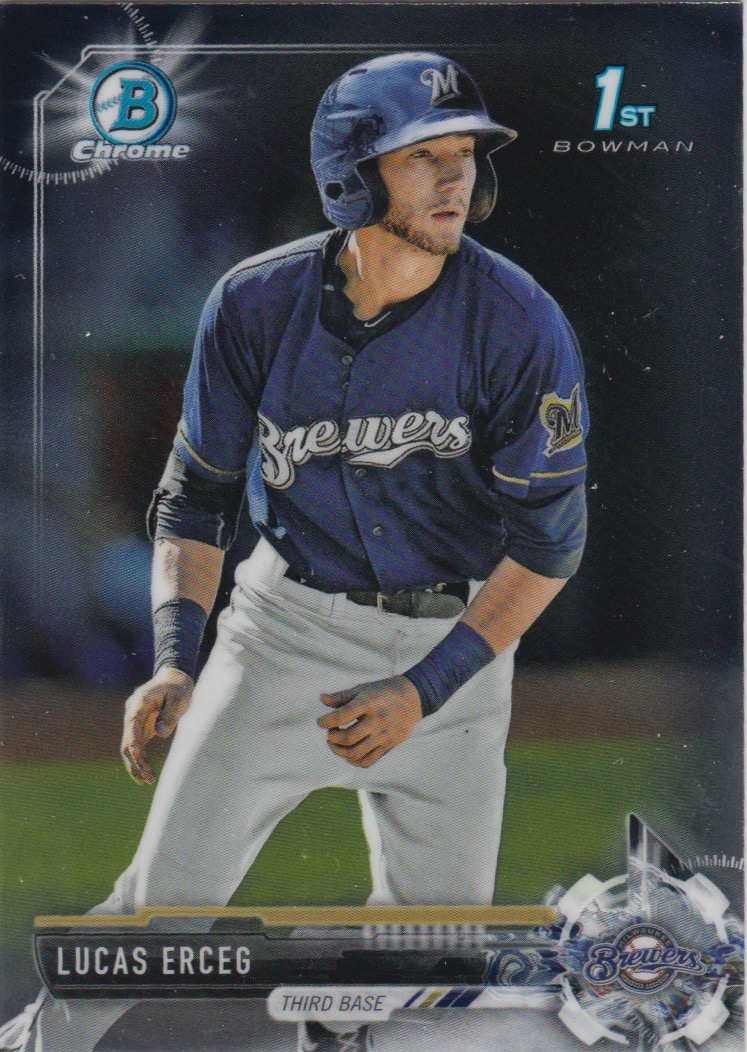
The 2017 Bowman case break excited me. The Brewers farm system is one of the best, and (for a change) the Brewers were reasonably well represented in the prospect set. Sure, they didn't have the most cards in the prospect range -- that honor went to the Yankees, of course, with Topps's usual over-abundant love for all things Yankees...I mean, it's still Topps, after all -- but the Brewers did get six players in the set: 3B Lucas Erceg (#7 MIL prospect), P Freddy Peralta (#19), SS/2B Mauricio Dubon (#9) P Phil Bickford (#12), P Josh Hader (#3) and P Luis Ortiz (#4). 

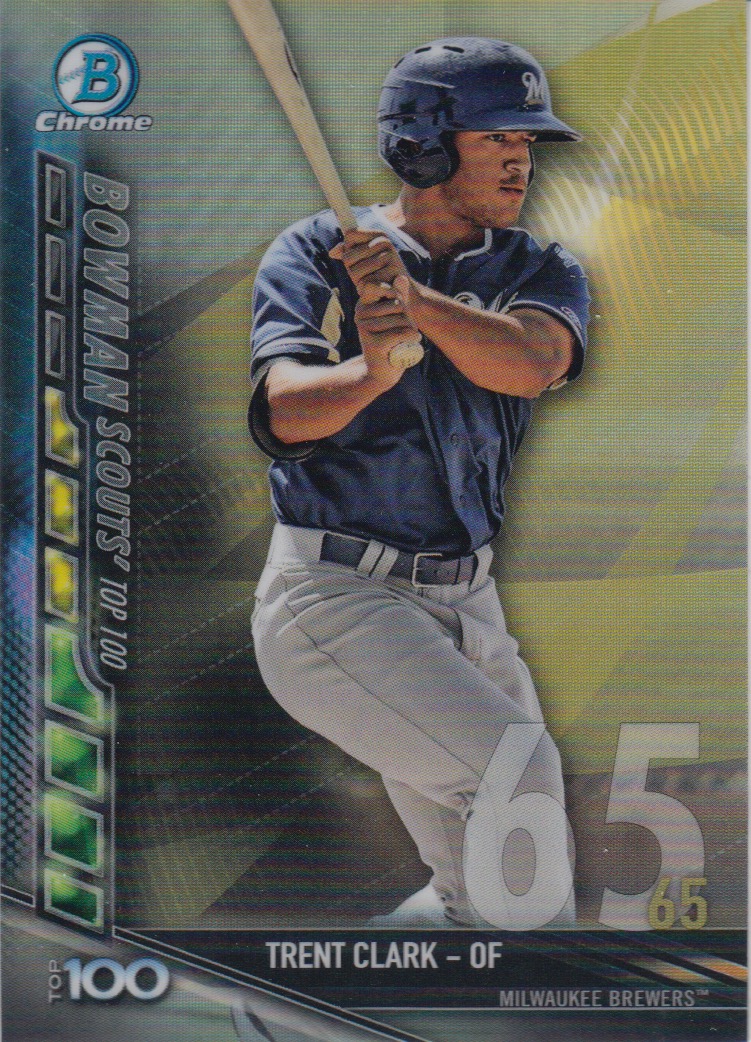
In addition, the Brewers have 7 players in the Bowman Scouts' Top 100: Hader, Ortiz, Bickford, Corey Ray, Lewis Brinson, Trent Clark, and Isan Diaz. Throw in some chrome prospect autographs and a couple of those Scouts' Top 100 autographs in addition to a few other inserts, and I had hope for a really nice return from the case.

So, before we evaluate this case, let's look at the cards. First, the Major League base:


The Bowman brand scaled back the base cards to just 100 major leaguers. You can tell how much in advance that the checklist was put together, though, because the set featured an entirely unnecessary card for David Ortiz, whose love from Topps last year put the fawning over the New York Yankee Rookie flavor of the month to shame. So, with its usual ham-handedness, we get 7 Cubs and 7 Red Sox (and 7 Astros!) from Topps, but only 1 Red (Votto), 1 Angel (Trout), and just 3 Indians, a team I could have sworn played against the Cubs in the World Series last year.

The only Brewer missing here that has shown up in almost every other set this year is Jonathan Villar, last year's stolen base leader in the National League whose struggles at the plate during the first two months of this season have a lot of Brewers fans concerned. I can understand the concern, of course -- it's never good to have a guy slashing at .210/.284/.319 and striking out as many times (71 in 233 plate appearances) as he has. But, he did change positions to second base, and that adjustment can take away from a person's other abilities. It's not easy to change a mindset like that, and I'm sure he focused a lot on fielding in spring training this year.

Okay, let's move onto the paper prospect base cards:


Design-wise, Bowman's design this year seems to be following the trend that the Flagship has set: lots of blurry backgrounds, weird smoke/haze/fog effects on the margins of the cards, and a logo and nameplate area that appears to be designed for ease of use within the Bunt app rather than for use as a physical card. The problem with this, especially when we are talking about Bowman and its parallel-happy printing job, is that some of the parallels are nearly impossible to notice as parallels.


Such as the Silver parallel. The card on the right is the Silver parallel for Freddy Peralta and it is serial numbered to 499. The card on the left is his base card. You have to look really closely to notice that there is a silver coloration in the upper left hand corner near the Bowman logo and along the nameplate at the bottom. Or, you have to run the card under lights and move it back and forth to see the little dotted line feature that comes across far better on the scan here along the left-hand side of the card.

Unfortunately for me, this Peralta was the only Brewers parallel of any kind that came in the case. 

On to the Chrome:


During the video, every time a Chrome card showed up, the lights in Chris's house made it appear as if the card was a refractor. The Chrome parallel is really shiny this year. 

Unfortunately for me, I did not get any refractors -- only base Chrome Prospects cards.

As I mentioned above, the Brewers have seven players in the Scouts' Top 100. I didn't do very well here either:


Out of the 7, I only got 2. The collation on the boxes in this case was terrible. I actually received a total of four cards of the Brewers in this subset -- three of Trent Clark to go with the Brinson. Now, don't get me wrong -- I'm a Trent Clark fan, even if he is essentially a top trade chip with the outfield depth within the Brewer system -- but it would have been nice to get other Brewers from the subset. 

Instead, I'm now surfing eBay to look at pricing on getting the rest.

There were other inserts in the set as well:


I've mentioned this elsewhere before, but it seems like typical Topps to jam Orlando Arcia into the "2017 Rookie of the Year Favorites" subset. Why? Because Arcia is not rookie-eligible any more. Like I said about the David Ortiz card, Topps/Bowman clearly put the checklist together way too early -- I'm guessing that they started in mid-year last year -- and didn't fact check themselves after the season to make sure that everyone listed as a ROY favorite was eligible for the award.

Arcia isn't the only one is this position, either. Alex Bregman and David Dahl also exceeded the number of at-bats/days on the active roster allowed to retain rookie status. So, out of a subset of 15 players allegedly highlighting potential Rookie of the Year candidates, fully 20% of them were not actually eligible to win the award.

Well done, Bowman!

So, you've now seen what I got from this case. All in all, it was quite honestly a terrible case for me. That's not Chris's fault, obviously -- he didn't put the cards in the case. But it means that I'm going to have to hit the aftermarket pretty hard to complete my Bowman run for this year. 


That's a real shame for me.

Saturday, June 3, 2017

Pins and Needles

One of the upsides of being on Twitter is sometimes the conversations go down rabbit trails of strange and weird and cool collectibles just by someone bringing up a random topic. Now, I can't recall how it is that Greg a/k/a @grogg came to send me some great player pins from 1990, but All Hail to him for that!


That song is from a Manchester Band called PINS -- an all-female band formed 6 years ago. The songs I've listed to have a very mod 1960s feel. There's a lot of that feel in the way they dress as well. If you'd like to hear something different from them, check out "Aggrophobe", which features Iggy Pop doing mostly spoken-word verses while singing the chorus together. It's a lot different than a lot of the songs I've listed to lately, and it's a nice change.


But, it is weird too.

So, the pins. 1990 featured some of the most diverse oddballs one can imagine. There were the collector-issued "Broder-type" cards, such as the "Blue Sox Sports Sports Promotions Action Superstars." You had your random unlicensed stuff, like the "1990 All-American Baseball Team." Those were fairly normal cards compared to others, though. A company called "Ace" put out a set of 108 MVP pins, defining the term MVP rather loosely to include luminaries such as Bill Doran, Gary Gaetti, Tom Herr, and Dennis Rasmussen with real MVPs such as Robin Yount, Kevin Mitchell, and Dale Murphy.

From there, things went even weirder. Good Humor Ice Cream issued a set of 26 "bats" (one for each team) that were the sticks on which your ice cream was frozen. Of course, you had your usual cola-sponsored or cookie-sponsored or fast-food-sponsored sets. MSA was back at its disc-creating best. And don't forget about all the random player-specific sets that the Star Company put out, including the 1990 version of Aaron Judge: Kevin Maas.

All in all, having a set called "Baseball Buttons" that was fully licensed was nothing out of the ordinary for 1990. It appears that the set was broken down colorwise by having the NL players with a blue button and the AL players with a red button. I'm not entirely sure where Trading Card Database got its numbering system for the set, though, as I personally do not see any numbers on the buttons. 

It's a truly weird set in many respects. The Los Angeles Dodgers were just two years -- basically one season -- removed from winning the World Series, but only three Dodgers made the 120-button set. On the other hand, the Brewers had seven buttons in the set.


It's like the Baseball Button people were the Anti-Topps. The designs on these leave a lot to be desired. Why do Ted Higuera and Dan Plesac have their name and a copyright line included on their photos while the other players do not? 

The photographer who took the photos of Yount and Gantner must have been new to the business as well -- you never take a photo where the sun is behind a person's face if you are intending to feature the face in the photo. That's photography 101. At a minimum, you need additional lighting in that case to light up their face. If you don't you end up with a dark photo that makes it difficult to tell Jim Gantner and Robin Yount apart without a label.

Still, I'm not complaining about these. Like I said, this set is like the anti-Topps -- featuring far more Brewers than it even should. This package helped bring my Yount collection total to 1,052 items, including ninety-seven from 1990 alone.

Many thanks go out to Greg -- he's a great guy, a good follow on Twitter, and he has great movie recommendations too. 

Tuesday, May 30, 2017

Pyramid Ratings and the 2017 Milwaukee Brewers

In January, the excellent baseball website Hardball Times had an article by Paul Moehringer called "The Pyramid Rating System's All-Time Milwaukee Brewers/Braves." The basic conceit behind the article is set forth in the article talking about the Baltimore Orioles all-time team: to build a modern team -- 12 pitchers with 5 starters, 6 relievers, and a spot starter and 13 position players, including 2 catchers -- based around the historical teams. 

The author focused on a city-centric approach rather than a franchise approach, which means, for example, that the Washington Senators' various iterations are made a part of the Washington Nationals' franchise history. This means, too, that former franchises including the Philadelphia Athletics, the Montreal Expos, the Brooklyn Dodgers, the Boston Braves, the New York Giants, and the St. Louis Browns are resurrected. From there, the author creates 6 divisions of 6 teams each named after the current divisions. 

The Milwaukee "franchise" is placed in the AL Central alongside the Chicago White Sox, Cleveland Indians, Detroit Tigers, St. Louis Browns, and Tampa Bay Rays. The thought behind putting the Milwaukee Braves with the Brewers is that if the Braves had never left, Atlanta would have gotten a team anyway but the Brewers would never have existed. The final rule is that players can only be placed on one team -- so Warren Spahn ends up on the Boston Braves, thereby depriving the Milwaukee team of its clear, by far best pitcher.

The Milwaukee team is heavy on hitting. Very heavy. At the same time, the pitching is as thin as tissue paper. Milwaukee's best pitcher in its history is the one pitcher who "dominated over an extended period of time": Teddy Higuera. Seriously, that's it. 

In terms of the starting lineups, it's again a very interesting set up. I'm going to use it to introduce the cards I bought recently from Brent Williams off eBay to try and guess what chances the guys in this year's sets have of making it to the "all-time team."

Let's start with the easy one:


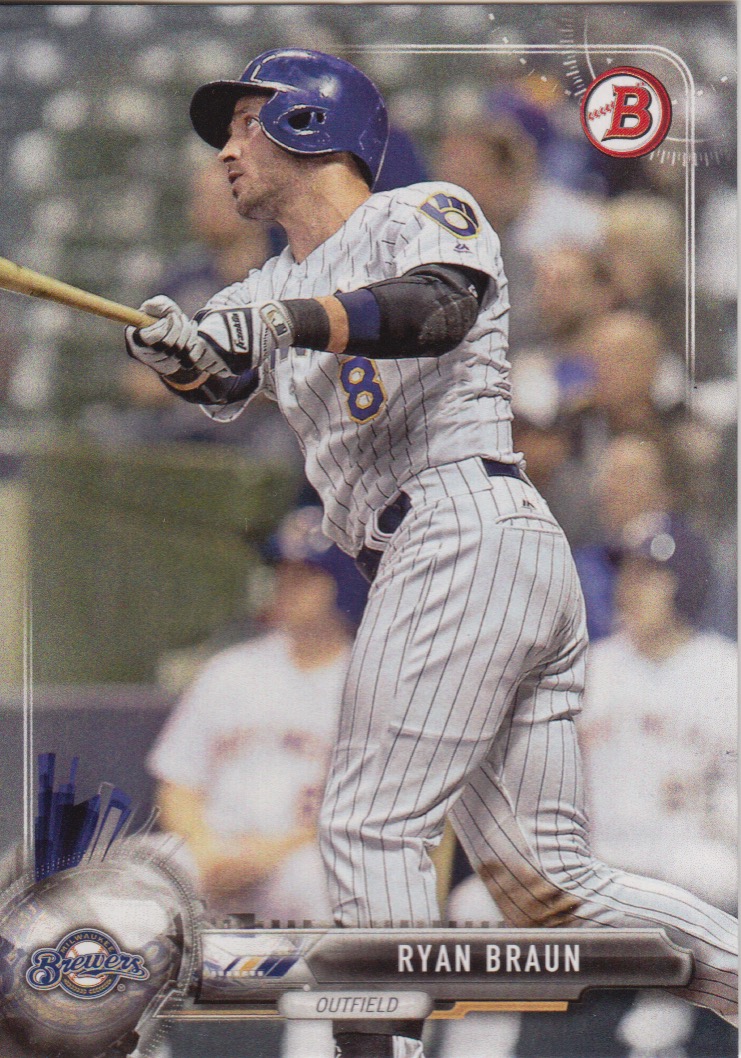
That's a whole lot of Ryan Braun, and for good reason: Braun is the starting left-fielder on the Milwaukee team. The projected starting lineup puts him hitting third against righties and second against lefties. It's actually a pretty incredible lineup: against righties, the lineup is constructed with Eddie Mathews leading off. As the article notes, Mathews led the NL in walks four times, including three straight years from 1961 to 1963. He finished in the top-10 in OBP in the NL 10 times. 

Yeah, Eddie Mathews was really, really damn good. 

Braun was a shoo-in for a spot on the team, even if he is the only non-Hall of Fame starting outfielder alongside CF Robin Yount and RF Hank Aaron. He's backed up by Carlos Gomez and Gorman Thomas and, if necessary, Hank Aaron. Other than Braun, the other four outfielders on the team all played centerfield for significant portions of their career.

Now, onto the totally speculative:


With Orlando Arcia, we have very little to go on currently. Hitting-wise, he is improving. He is getting used to being in the big league. He chalks up a recent 9-game hitting streak to better pitch recognition:

And props to Sophia Minnaert for being bilingual. As a quick aside, I'm a big fan of sideline reporters who are bilingual and can translate on the fly. Atlanta United has Brittany Arnold who can do the same thing, and I feel like it is important so that we get to hear from guys like Arcia (or Miguel Almiron with ATLUTD) directly just the same as the English speakers who get interviewed on ESPN.


Back to the Milwaukee team. The Brewers/Braves roster only includes Yount and Braves stalwart Johnny Logan at shortstop (though Bill Hall could play the spot in a pinch). Logan was one of the all-time best defensive shortstops ever, and he was not a complete zero with the bat (OPS+ career of 94). Because Yount can play short, though, the author felt justified in carrying Gorman Thomas to destroy lefties.

If Arcia can develop further -- continuing to improve his pitch recognition, continuing to keep his strikeouts down, learning how to read pitchers on the basepaths, and the like and, further, assuming that he spends a good amount of his career in Milwaukee -- then there is a very good chance that he could end up displacing Logan. He is still very young -- turning 23 in August -- so that development time will be interesting to watch.


Next up: Jonathan Villar. Based off last season, if Villar could have been projected out from there, he would have been difficult to leave off the roster. This year has seen him come back down some -- he is hitting terribly this year -- so it's an open question as to what he can be or is.

He would be hard-pressed to be a starter on the all-time Milwaukee team since the team lines up another Hall of Famer there: Paul Molitor. Molitor could have been put at a number of positions, but second base was the best fit. Behind Molitor, the team would have long-time underrated Brewer Don Money, who could fill in both at second and at third. Money was such a good fielder at third base that he set a major league record with 86 straight games without an error in 1974. Despite that, he ended up being the AL All-Star starter at second in 1978 -- playing there while Molitor played short and Yount played golf.

Long-time Brewer Jim Gantner made the 40-man roster as a 2B/3B fill-in as well, and Bill Hall could slot in here at second as well. So, odd as it may sound, Villar joins a long line of Brewers with positional flexibility in the infield. Molitor, Money, Gantner, and Hall all played all over the infield, with only Gantner not being at least a part-time starter at shortstop in that time (he started 5 games at short in his career). 

All the caveats about time in Milwaukee apply to Villar, and if he can produce near what he did last year, he has a good shot to get onto the roster at a minimum. Don't underrate Don Money here, though: during his 11 years in Milwaukee, he hit .270/.338/.421 for an OPS+ of 114, including four all-star games. He platooned from 1979 through 1983, but he always had good power.


Welcome to the black hole that is pitching in Milwaukee. I supposed Davies and Nelson have as good a chance as anyone to make it into the mix for a slot pitching for the Milwaukee "Brewers" all-timers. To give you an idea of what I mean by black hole, here's the pitching staff:

SP: Higuera, Ben Sheets, Mike Caldwell, Chris Bosio, and Bill Wegman
Closer: Ken Sanders
8th inning: Dan Plesac
7th Inning: Tom Murphy
Setup: Chuck Crim and Dave Jolly
Mop-up: Braves P Don McMahon
Spot Starter: Lew Burdette

Others on the 40-man: Ricky Bones, Bob Buhl, Doug Davis, Cal Eldred, Mike Fetters, Ray Searage, and Bob Wickman

I'm a little surprised that Yovani Gallardo did not make the team over Doug Davis or Ricky Bones or even Chris Bosio. I have tweeted at him and left a comment to see his reasoning (or to see if Yovani just got missed in the shuffle).

So, either of these guys could get there, I suppose. But I kind of doubt it. 


No chance. Not unless Scooter ends up back in Milwaukee, jacks up on steroids, and suddenly turns into a lefty-hitting Bret Boone or Jeff Kent. 

Since these guys are no-hopers, let's look at the catching slot and at first base. I've mentioned in the past about how Del Crandall was really a star in his day. He ends up getting the nod as a part of a platoon with Jonathan Lucroy. Not bad. But, if we look at how the 40-man stacks up, we find Joe Torre listed as a C/1B. That's weird because I think of Torre as a Cardinal thanks to his MVP season there. As the article points out, though, Torre's career essentially gets split four ways thanks to the way that the pyramid system is structured -- his Braves time is half Milwaukee, half Atlanta -- and his best season was 1971 with St. Louis. 

At first base, we plug in Cecil Cooper. Arguably, that's a difficult slot too. Prince Fielder becomes a platoon DH who will absolutely annihilate right-handed pitching as a 1-2 punch with Eddie Mathews (career for Fielder against RHP: .294/.403/.539: a .942 OPS...which is basically Willie Mays), though Fielder sits against lefties to allow Gorman Thomas to mash. On the 40-man, George Scott beats out Joe Adcock for the spot thanks to the fact that Scott won five Gold Gloves in Milwaukee while also crushing the ball (.283/.342/.456).

I highly recommend reading the articles on Hardball Times about your favorite team's all-time team. Sure, the clubs like the Red Sox and the Yankees -- with their long histories -- have a distinct advantage over newcomers like the Marlins or the Brewers or the Padres. But it sure is fun to revisit those old names.

And, while you're at it, look up Brent Williams on eBay and Twitter -- he's a collector who sells rather than being just a seller.