Showing posts with label 1971 O-Pee-Chee. Show all posts

Sunday, July 7, 2019

Meet the Brewers #44: Wayne Twitchell

As is usual in September for teams going nowhere, the 1970 Brewers called up a few guys from the minors to give them an opportunity to be around the big club and dip their toes into the big league waters. Such was the case on September 7, 1970, when another tall righty pitcher from the Brewers system made his debut in the first game of a doubleheader.

Six-foot, six-inch tall Wayne Twitchell was summoned from the bullpen for the bottom of the fifth inning with the Brewers having rebounded in the top of the inning from 7-1 down to pull within 7-4 against the Minnesota Twins. Twitchell was tossed into the deep end -- he was asked to face the heart of the Twins order...the 4-5-6 hitters. The first guy Twitchell ever faced in the big leagues was Hall of Famer Harmon Killebrew, and Twitchell struck him out. In fact, Twitchell struck out all three guys he got for outs in his first inning of work -- sandwiching an error by Roberto Pena and a walk in between each out.

1971 Topps/O-Pee-Chee
Wayne Lee Twitchell was born on March 10, 1948 in Portland, Oregon. As is often the case for players in this era, Twitchell was a multisport star in high school and was named to the Oregon All-State team in both football and baseball. According to the excellent SABR biography for Twitchell, he had the chance to play college football at Arizona State. If he had done that, he would have been following in his father's footsteps, as his dad was a standout running back for Oregon State in the 1930s. 

When decision time came, however, a new option had arisen. Twitchell was selected third overall in the 1966 MLB Draft by the Houston Astros -- behind complete washout Steve Chilcott and Hall of Famer Reggie Jackson. Twitchell's dad had warned Wayne that his family had a history of knee problems, and those problems would have only been exacerbated by trying to play football. 

So, baseball it was. Twitchell was known for being a hard thrower with questionable command, and he toiled for four up-and-down seasons in the Astros organization. As he put it himself, "I always seem[ed] to have the knack of always bringing the teacher out in people. I was taught close to 20 different deliveries, which complicated things." 

The Astros gave up on Twitchell in November of 1969 and sold his contract to the Seattle Pilots. Twitchell was ecstatic to be pitching back in the Pacific Northwest. That ecstasy was dashed when the team was sold and moved to Milwaukee, but Twitchell spent 1970 at home in Portland in Triple-A -- and met his future wife that year as well. 

Twitchell only appeared in 2 games for the Brewers in September of 1970. His second outing was much worse than the first, as he gave up three hits and two earned runs in 2/3 of an inning. Interestingly, Twitchell recorded those two outs by way of a strikeout as well. So, for his Brewers "career," Twitchell has a K/9 of 27. Only the immortal Ray Krawcyzk of the 1989 Brewers finished with more Ks and a K/9 of 27, striking out 6 in 2 innings of work on April 28, 1989 in his only Brewers appearance.

Still, things between Twitchell and Milwaukee were not good. Twitchell's SABR bio quotes him as saying that he "just didn't fit in with Milwaukee. They had their ideas about pitching and it wasn't about my style. I was a fastball pitcher and they were trying to make me into a spot pitcher." This quote makes me wonder if, perhaps, the organizational ethos over the years held back the team from developing pitchers. Obviously things changed a lot in the early years, and that couldn't have helped either.

1994 Miller 25th Anniversary Set
Despite being a 22-year-old pitcher with a history of being a first round pick and for whatever reason, the Brewers gave up on Twitchell quickly as well. At the end of spring training in 1971, Twitchell was traded to Philadelphia for minor league outfielder Patrick Srkable. Skrable played one year of 70 games in Triple-A for Milwaukee and was done. Twitchell himself said that he almost quit baseball after he was traded. 

Thankfully for him, he was sent first to Triple-A Eugene in Oregon. Surrounded by family and his new wife and having a manager in Andy Seminick who left him alone, Twitchell pitched for the last time in the minor leagues -- because he spent the next 9 seasons in the major leagues. Called up to the majors in 1971, Twitchell blossomed in Philadelphia and made the All-Star team in 1973.

Unfortunately, just as Wayne was getting on a roll, those knee problems from the Twitchell family history kicked up. Billy Williams of the Chicago Cubs was trying to beat out an infield single on September 18, 1973 at Wrigley Field and slid head first into Twitchell's knee. That was the end of his season and led to a four-hour surgery and eight weeks in a full leg cast. The rehab was brutal and necessary; his doctor told him that if he didn't follow his rehab to the tee "you'll never walk normal again."

From that 1973 season, it was downhill. Twitchell stayed in Philadelphia into 1977, with his only real success being in 1976 -- a 1.75 ERA and a 3.72 K/BB ratio working mainly as a reliever. Stats like that make me wonder if he wasn't misplaced in the starting rotation. He was traded in 1977 to the Expos on June 15, and stayed there through the 1978 season. In 1979, he pitched in 33 games for the Mets before his contract was purchased in August of 1979 by Seattle. Finally getting to pitch for his "hometown" team had to be a pleasure for him, but he was released after the season and was done with baseball.

After his baseball career, he moved back to Oregon and became a commercial real-estate broker. He fought cancer for quite some time, but lost that battle on September 16, 2010, aged just 62 years old.

The three cards that picture Twitchell as a Brewer are shown above. I don't have any of the 1971 cards, as that card is from the difficult-to-find high number set. Weirdly, by the time that the card came out, Twitchell had long since been traded to Philly, but I guess that card had been designed long before. It's also weird to me that the Brewers/Miller used a New York Mets photo for his 1994 Miller card -- I guess it's all they could find.

Saturday, June 22, 2019

Meet the Brewers #43: Floyd Wicker

On September 4, 1970, two dead-end teams were playing out the string in front of a disinterested collection of less than 12,000 people in an almost entirely pointless one-game series on the Friday before Labor Day in Milwaukee. The 49-90 Chicago White Sox limped into Milwaukee in the middle of what would become the Sox's longest losing streak of the season -- 8 games. For their part, the Brewers were not any great shakes either, as the second year team was carrying a 52-85 record.

Brewer #43, outfielder Floyd Wicker, joined the festivities as a pinch hitter for Bernie Smith in the bottom of the eighth inning; Wicker promptly tapped out to the pitcher for the final out of the inning, stranding Tommy Harper at second and then replaced Smith in RF. Yet, Wicker would eventually be the hero of the game. The slog between the two worst teams in the American League went into extra innings tied at 2, and Wicker broke the tie with a single in the bottom of the 10th to drive in Harper for the walk-off victory.

1971 Dell Today's Team Stamps. Wicker's airbrushed Expos hat is in the Brewers' book.
Floyd Euliss Wicker was born in Burlington, North Carolina in 1943. He went to East Carolina University for one season as a 16-year-old, turning 17 in the fall of that freshman year. As a freshman, his team won the NAIA national championship. According to the ECU yearbook for that year, Wicker was the third baseman for that team. 

The major league rules being what they were at the time, his ability drew attention from scouts and he signed after just one year of college with the St. Louis Cardinals. Wicker did an interview in 2012 on a blog called The Baseball Historian where he stated that he had had the chance to sign as a professional right out of high school, but he chose a year of college near home instead.

He played in the Cardinals system in Classes C and D at the ages of 17 and 18 for his first two years in the minors, and he then moved up to A ball in 1963. At that point, his career was interrupted by two years of military service. He still played three to five games a week in the service, but it is hard to say that he faced the same level of competition there as he would have in the majors. 

1971 Topps/O-Pee-Chee
Wicker came back to the Cardinals organization in 1965. He was pushed to Double-A in 1966 and responded with a big season -- .303/.392/.417. He followed that up with a creditable year in 1967 at Triple-A Tulsa and a good spring in 1968 such that he put himself on the Cardinals radar for when their other outfielders had to serve their military service. As such, in 1968, Wicker made his big-league debut on June 23 as a pinch hitter. He appeared in 5 games for St. Louis in total, all as a pinch hitter or pinch runner.

Apparently, that was not enough for the Cardinals to make sure that Wicker was on their 40-man roster, however, and the Montreal Expos swiped him from the Cardinals in the Rule 5 draft after the 1968 season. The Expos gave him 41 plate appearances -- all but one against right-handed pitching for the lefty-hitting Wicker -- and he struggled mightily with an anemic slash line of .103/.146/.103. In fairness, it's tough enough to hit in the major leagues, but it's even tougher when you only get 24 plate appearances between May 16 and September. On the other hand, you don't help yourself when you fail to get a hit in any of those 24 plate appearances.

That Rule 5 season turned into a lost year for Wicker -- one he never got back developmentally. As soon as the season ended, Wicker was named as the player-to-be-named later in a trade in which the Expos received Marv Staehle from the Seattle Pilots. 

Wicker spent most of 1970 in Portland and had an excellent year in AAA -- .329/.441/.521 with 14 HR and 78 BB in 471 plate appearances. He also featured in a Ray Peters story, in that Ray used Floyd's bat to hit the one and only professional home run that Ray ever hit -- a grand slam for the Beavers the week before Ray got married. 

Thus, Wicker got a call up to the Brewers in September. Wicker then played in 11 games in 1971 starting April 30 and ending May 30 for Milwaukee. Again, he struggled for playing time -- getting only 10 plate appearances and never getting a start for the Brewers. He was then traded on June 1, 1971 to the San Francisco Giants in exchange for utility infielder Bob Heise. 

1994 Miller 25th Anniversary commemorative set
Wicker's professional baseball career ended in 1971. As he detailed in an interview in The Times News (Burlington, NC) in 2012, even though he stopped being a pro, he still loved the game. After he left baseball, he went to work for the United States Postal Service for 33 years, retiring in 2005. During that time, he helped out the Southern Alamance High School and Middle School baseball teams and even coached American Legion ball in the 1980s. 

Wicker still shows up in newspapers in the area of North Carolina where he lives. The 2012 article above was done in conjunction with his receipt of the Distinguished Service in Sports Award that he received from the Alamance County Sports Development Counsel. The article notes his heavy involvement with the North Carolina Baseball Museum and his role in getting two teams from the 1910s from his old high school recognized there as champions. Many of the articles with him involved are for golf tournaments for fundraising for that Museum. 

Floyd Wicker has 4 total cards as a Milwaukee Brewer as shown above. I actually own all of them.

Saturday, May 4, 2019

Meet the Brewers #42: Pete Koegel

When rosters expanded in September of 1970, the Brewers were quick to make some moves. 

One of the moves made no difference on the field but made every difference in the world to a long-time Milwaukeean: the Brewers signed Harvey Kuenn to a free agent contract and placed him on the active roster to allow him to accrue additional service time to max out his MLB pension. The 39-year-old Kuenn did not get an at bat -- unsurprising since he had been serving as a coach all year and had not played in the majors since 1966. But, it was the thought that counted to Harvey; he became a fierce supporter of Bud Selig from that point forward.

Another more run-of-the-mill transaction also occurred on September 1: minor leaguers getting called up to get a cup of coffee in the majors. Such was the case for Brewers prospect Pete Koegel. Koegel came in to pinch hit in the bottom of the sixth inning for starting pitcher Lew Krausse against Twins ace Jim Perry, who won his 20th game that day and went on to win 24. Alas, Pete tapped out to Perry in his first ever major league at bat. Koegel went on to bat just 9 times total that September, but he did hit his first and only major league homer on September 25 against a guy who should be in the Hall of Fame -- Tommy John.


1971 Topps/O-Pee-Chee
Peter John Koegel was born and raised in Seaford, New York, which is on Long Island about three or four towns west of Amityville and south of the famous suburb Levittown. Koegel was drafted straight out of high school by the Kansas City Athletics in the fourth round of the first-ever draft

Koegel was known for his prodigious power even in high school. He was voted the most valuable player in the Hearst Sandlot Classic, played August 21, 1965 in Yankee Stadium, after slamming a 420-foot triple just shy of the auxiliary scoreboard in deep left field in old Yankee Stadium. He received the MVP trophy from Lou Gehrig's widow, Eleanor, days before signing for a $45,000 bonus with the A's. 

Thanks to that bonus and his hitting skills, Koegel was immediately assigned to the Midwest League for his first minor league experience. As an 18-year-old who was about 3 years younger than the average player, he slashed .233/.319/.450 and smacked 21 HR and even stole 10 bases. His team paced the league with 117 HR that season, so he may have been the beneficiary of a favorable home park -- the next highest was 93, and the worst was the San Francisco affiliate, which hit 23 as a team! Still, Koegel hit homers throughout his minor league career everywhere he went, finishing his career with 175 HRs in 1238 minor league games (4722 plate appearances, .248/.335/.429 slash line).

Koegel joined the A's at the time that they were putting together quite a good farm system. During spring training in 1967, he was vying for playing time against such notables as Joe Rudi and Reggie Jackson in the outfield and Dave Duncan at catcher. 

Even in the Arizona rookie league in 1966, he had to contend with future big leaguer Ted Ford, and the A's also had future Brewer Sal Bando playing the position a step higher in the organization.That rookie league team was stacked. It included Rick Monday, Dave Nelson, Cito Gaston, Reggie Jackson, Duffy Dyer, and Rollie FIngers. Later in his career, he shared minor league fields with Vida Blue, Gene Tenace, and Skip Lockwood. The A's did some great player identification work in that 1965 draft.

1994 Miller Commemorative Set
As Koegel worked his way up in the A's system, the biggest problem he had was finding a position. He played third in Arizona, outfield in his first pro season, first base and outfield in his second season, and mostly outfield after that. But when you're behind and play the same position as Joe Rudi, Rick Monday, and Reggie Jackson, you become expendable quickly. 

As a result, Koegel joined the Pilots organization in August of 1969 when the now-Oakland A's decided they wanted Jim Bouton's archenemy Fred Talbot and sent Koegel and Bob Meyer (Brewer #14) to Seattle. It was in the Milwaukee system that an attempt to put Koegel behind the plate as a catcher was tried -- just to get him on the field. 

Koegel went on to play in just nine total games for the Brewers -- 7 in 1970 and 2 in 1971. He was then shipped out by Frank "Trader" Lane along with friend of the blog Ray Peters to the Philadelphia Phillies for John Briggs on April 22, 1971.

Nothing personal, Ray or Pete, but I think Lane got the better of that deal. Maybe it was due to Ray messing up his shoulder in 1971, but Briggs spent parts of 5 seasons with Milwaukee and hit 80 HRs with the club and sported an OPS+ of 131 (31% above league average) over that time.

2018 Topps Heritage Pilots Autograph
After that trade to the Phillies, Koegel appeared in a total of 20 games in the major leagues, with 12 of those appearances being at catcher. Thanks to those 12 games, however, Pete is still the owner of a major league record: at 6-feet-6-inches tall, Pete is tied with Don Gile and Grayson Greiner as the tallest players ever to play catcher in the major leagues. Greiner is the most recent of the three to play, making his debut last year in May.

Because Ray Peters is still in contact with Pete, I asked Ray to ask Pete if the measurement of 6'6" tall was legitimate or if it was like college football measurements -- you know, a little bit of "extra" getting added in to improve appearances. Pete passed along that this is a legitimate measurement -- and in fact shorts him by 1/2"! He was measured at 6'6-1/2" by the United States Government for his military draft physical -- and that half inch meant that he was too tall for military service!

For what it's worth, the 1970 Milwaukee Brewers in spring training had the beginning of a good pickup basketball team. With Pete at 6'6-1/2" tall and with Ray Peters measuring nearly exactly the same, the team also had Gene Brabender at 6'5" tall, Wayne Twitchell at 6'6" tall, and 1971 debutante Bill Parsons also standing 6'6". Add in Don Bryant, who was a Rule V draftee (who was returned to the Astros) and stood about 6'5" tall as well, and you can go 6 players deep!

Ray also passed along a great story that Pete told about height. Pete was watching the MLB game of the week, and Tim McCarver was interviewing Dave Winfield. Winfield also stands a legitimate 6'6" tall, and he made two innings of appearances at third base. Winfield then claimed to be the tallest ever third baseman, and McCarver quickly corrected him to say that no, Pete Koegel is taller than you and he played 4 games at third in 1972.

Finally, Pete was a prodigious hitter in the winter leagues. While I am not sure what records he set with Leones, this Pinterest page says he has some. Plus, it gave us this great shot of Pete after the 1970s caught up to his facial hair:


My thanks to Ray Peters for giving me some great stories from Pete and about Pete, and thank you for reading. Koegel's three Brewers/Pilots cards are shown above, and I am missing the autographed 2018 Pilots Heritage card from last year.

Wednesday, December 27, 2017

Meet the Brewers #39: Bernie Smith

It's about time that I get back to writing about one of my favorite interests: the history of the Brewers. Today, we get to Brewer #39, Bernie Smith. Bernie debuted with the Brewers by playing in both halves of a July 31 doubleheader in which the Brewers were swept by the New York Yankees. 


1971 Topps
Calvin Bernard Smith has an incredible story for a man who who only played in 59 games and got 127 plate appearances between 1970 and 1971 as his entire big-league career. Smith was 28 years old -- almost 29 -- when he made his debut in Milwaukee. He got his first hit in the nightcap of the doubleheader: an infield single off Fritz Peterson. How Smith arrived at that point in time, though, is the intriguing part.

He was listed at 5'9" tall and allegedly weighed 164 pounds. In the two long articles about him that I have read, however, Bernie immediately laughed those numbers off and admitted that he might reach 5'7" tall in spikes and played at 152 pounds. Being so slight of stature hampered his opportunities. While he attended Southern University in Baton Rouge -- a school which 30 years later produced Brewers first round pick Rickie Weeks -- Bernie Smith did not play baseball at Southern. He was too busy trying to get signed to play pro baseball.

His efforts to get signed led him to simply show up in Columbus, Georgia, in 1962 in the spring at Mets minor-league training camp. By "simply show up," I don't mean that Mr. Smith hopped in his car and drove from his hometown of Lutcher, Louisiana, to Columbus. Oh no. Despite being a black man in the Jim Crow South travelling over 400 miles on the hopes of getting a shot to play minor league baseball and despite that timeframe being in the wake of the Freedom Rider movement, Bernie Smith hitchhiked the 400+ mile trip to ask for a tryout.

That took serious guts and serious self-belief.

1971 O-Pee-Chee

He played well enough to get signed to play at Class D Auburn in the New York-Penn League. Not long after, he became a regular outfielder. As the year progressed, Bernie proved to be the best player on the team and was named the Auburn Mets MVP for the year. 

The Baby Mets ended up winning the playoffs of the NY-Penn League that year. Despite his starring role on the team, however, Bernie was not going to be able to afford coming from Lutcher all the way to upstate New York for the annual Mets baseball dinner. As the February 23, 1963, The Sporting News article noted, Bernie was the lowest paid player on that team, so not being able to afford getting to the dinner is perhaps unsurprising. But he made the dinner anyway -- because the guards and prisoners at the state penitentiary in Auburn chipped in to thank him for the excitement of the previous season to pay for Smith to come to Auburn by bus. The article noted that they raised enough money so that "Bernie could eat steaks during the trip."

Despite the auspicious debut in Class D, Smith hardly became a top prospect in the Mets system. He hit nearly everywhere -- over parts of 11 total seasons in the minors, he hit .287/.367/.408 with 87 HRs and 177 SB (though with 84 CS) in 5311 plate appearances. Yet, despite being named the MVP of the Eastern League in 1967 (451 PA, 4 HR, 50 RBI, 22 SB, 37 BB, 47 K, .306/.376/.405; that .306 made him the only qualifier to hit over .300), he barely got a chance with the Mets system as players like Ron Swoboda and Ed Kranepool passed him by in the Mets' eyes. In 1968, he was optioned into the Pittsburgh system for a year at Triple A, but that didn't help either to be behind Clemente and Stargell. 

1994 Miller 25th Anniversary
Smith's break came when the Mets traded him to the Seattle Pilots for minor leaguer Gary Upton. His debut season of 1970 was dreamlike -- first major league hit, of course, and his first major league homer came in the top of the tenth inning on August 25, 1970 to win a game for the Brewers. His break was short-lived, though, as Smith got passed just as quickly in Milwaukee as he did in New York -- especially after the change in general managers after the 1970 season led to the acquisition of journeyman Andy Kosco. 

But that is not where the story ends in baseball for Bernie Smith. He had one last hurrah: he became the first black manager in the Midwest League, named as the manager of the Brewers affiliate Danville Warriors just a few days before Deacon Jones was named manager of the White Sox affiliate Appleton Foxes -- both for the 1973 season. And Bernie was much more successful than Jones. Jones's team suffered through a 15-game losing streak to start the season and finished the year 44-76. On the other hand, Danville finished 66-57 and won the Southern Division.

Yet, that was Bernie's end in baseball. It appears that he went back to Lutcher and opened a store there. That led to some legal and financial issues in the 1980s. To be clear, one of his legal issues sounds fishy in how police targeted his store in 1980, but it appeared that Bernie got in trouble for receiving and trying to sell stolen typewriters in his store. The warrant the police got was bogus, in my non-criminal-lawyer opinion. He received an excessive five-year sentence for the crime, and it happened shortly after his wife Creola had died suddenly after four sons had been born to them. His conviction was just ridiculous, in my book -- I feel assured that a white man in a similar circumstance (especially in the South in the early 1980s, but probably anywhere) would have gotten a lighter sentence.

At any rate, I know Bernie is still alive in Louisiana. I have been meaning to get in touch with him, and my failing to do so is what led me to hold off on writing this. But, now that I have written this up, there are so many questions.

Such as: what was it like to hitchhike to Georgia across the backroads of Mississippi and Alabama?

To close, you see the three baseball cards of Bernie Smith that appear in the Trading Card Database. I do not own the 1971 O-Pee-Chee of Bernie with George Kopacz, but I do own the Topps version and the Miller card.

Sunday, June 18, 2017

Meet the Brewers #38: Al Downing

Incredible as it seems, the 1970 Brewers reached the 38th player deployed for the team before the end of June. That seems incredible to me, at least. 1970 was a strange season, too, for the man who was Brewer #38 -- Al Downing -- as well. Downing came to the Brewers in a trade with the Oakland A's along with Brewer #34, Tito Francona, on June 11, yet Downing did not make his Milwaukee debut until June 28. That game was a disaster for Downing; he started the second game of a doubleheader against Oakland and did not make it out of the first inning.

1971 Topps
Alphonso Erwin Downing was born and raised in Trenton, New Jersey. A very good biography of him can be found on the SB Nation Yankees blog, Pinstripe Alley. Downing became a Yankee after spending one year at Rider University. The Yankees signed Downing on the recommendation and advice of former Negro Leaguer Bill Yancy. His first Spring Training in still-segregated Florida in 1961 must have been eye opening to the New Jersey native. This is not to say that he did not deal with discrimination in New Jersey, but the fact that he could not stay at the same hotel with his white teammates must have been incredibly difficult to deal with for him.

Despite the rather rude introduction, Downing did not spend much time in the minor leagues -- totalling only 59 games in the minors over his entire career and with 5 of those games coming in 1968 as he worked on recovering from an injury he suffered in the latter part of 1967

1971 O-Pee-Chee
Downing's time with the Yankees was up and down. He struggled with control early in his career -- leading the league in walks issued in 1964 with 120 in 244 innings -- but he paired that with being a big strikeout pitcher -- leading the league in strikeouts in that same 1964 season with 217. He had swing-and-miss stuff, from all indications, and only in his final season in the majors did he ever allow more than one hit per inning.

Downing was an All-Star in 1967 thanks to stellar work in the early part of that season. He pitched the 9th and 10th innings of that game (which extended to 15 innings before Tony Perez hit a game-winning homer off Catfish Hunter in the top of the 15th and Tom Seaver shut down the AL All-Stars in the bottom of that inning for the save). In his two innings of work, Downing retired Willie Mays, Roberto Clemente, Hank Aaron, Orlando Cepeda, Dick Allen, and Bill Mazeroski while surrendering hits to Jim Wynn and Ernie Banks.

As I mentioned above, however, 1970 was a strange season for Downing for a number of reasons -- but first and foremost because he was no longer a Yankee. According to news reports at the time (The Sporting News), the Yankees were looking for a right-handed hitter to play first base -- Ralph Houk claimed that the team was trying to boost its power hitting -- so the Yankees traded with Oakland for 10-homer-hitting Danny Cater (along with a minor-league outfielder named Ossie Chavarria). In that trade, the A's received Downing and catcher Frank Fernandez (who was made surplus to requirements by the emergence of Thurman Munson).

Dell Today's 1971 Sticker (from the Dodgers team book)
Downing did not get much of an opportunity in Oakland. At the time of his trade in early June, he had appeared in just ten of Oakland's 57 games. He had been dropped from the starting rotation after a bad start on May 6 and fell out of favor with the A's. As The Sporting News characterized the trade that sent him to Milwaukee as seeming to be a rip-off of sorts:
The trade that sent Tito Francona and Al Downing to the Brewers for Steve Hovley was a swap that exchanged a 24-year-old .280 hitter who can play all three outfield positions for a 36-year-old pinch hitter who might retire after this year and a pitcher who wasn't being used at all recently.
Indeed, that is exactly what it looked like at the time. If Hovley hadn't been squarely fifth in line in the Oakland outfield behind Felipe Alou, Rick Monday, Reggie Jackson, and Tommy Davis and if Hovley hadn't hit .190/.229/.200 after the trade, that is. 

Of course, Downing's record wasn't exactly great in Milwaukee either. He walked more guys than he struck out -- 59 walks and 53 strikeouts in 94-1/3 innings. As a result, Frank Lane did not hesitate to ship Downing out to the Los Angeles Dodgers in February of 1971 in exchange for Andy Kosco.

1994 Miller Brewing Commemorative Set
I said above that 1970 was an odd season for Downing. That is because Al Downing spent 9 seasons with the Yankees and 7 with the Dodgers. Sandwiched in between is that awkward 1970 season with Oakland and Milwaukee. 

Getting out of Milwaukee was great for Downing's career. He appeared to be rejuvenated on the West Coast. Indeed, 1971 was Downing's best season on surface statistics. He threw 262-1/3 innings for the Dodgers and finished with a 20-9 record and a 2.68 ERA. He also led the league in shutouts with five. Those stats were good enough to garner him a third-place finish in the Cy Young voting -- though Downing's season was nowhere near as good as the guys in front of him (Fergie Jenkins and Tom Seaver). The effort in 1971 led the writers to award him the National League Comeback Player of the Year Award.

That 1971 season -- along with his 1967 All-Star Game -- was the pinnacle of Downing's career. Most people of my generation and younger probably know Downing more as the guy who gave up Hank Aaron's 715th home run in 1974 at Atlanta-Fulton County Stadium. After he retired from baseball after the 1977 season, he worked as a radio broadcaster for the Dodgers for several years as well as putting in a season on radio with the Atlanta Braves in 2000. He's now retired and comes back to Yankee Stadium on a regular basis for their Old-Timers Day. In fact, he's scheduled to be at the 71st annual version of the event on June 25. 

As for the baseball card aspects, Al Downing appeared on four total cards as a Brewer -- the ones shown above. Ironically, he appears as a Brewer and is listed as a Brewer on just the one card -- the 1971 Topps card above -- while being listed as a Dodger on two cards showing him as a Brewer. Then, when it came time for the Miller Brewing Commemorative set in 1994, the Brewers and Miller could only find a photo of him with the Dodgers. I have the 1971 Topps card and the 1994 Miller card, but not the 1971 O-Pee-Chee or the Dell Today's 1971 Baseball Sticker.

Wednesday, August 31, 2016

Meet the Brewers #32: Ken Sanders

With the placement of two pitchers on the DL and Marvin Milkes's incessant chopping and changing of the roster, additional bodies were needed in Milwaukee at the end of May in 1970. Thus, a reliever with a checkered history in major league baseball received the call up to the major leagues -- Ken Sanders. Sanders's first game in Milwaukee came on May 30, 1970

The Brewers had raced out to a five-run lead in the first-inning of the game -- thanks in large part to a hit by Brewer #30, Roberto Pena...an inside-the-park grand slam home run (a play on which Al Kaline almost choked on his own tongue and died on the field) -- but starter Lew Krausse faltered and gave up 6 runs and the lead. Thus, in the fifth inning, the call to the bullpen for Sanders came. He pitched okay -- giving up one run in 2-2/3 innings -- and the Brewers came back to win the game after that.


1971 Topps/O-Pee-Chee
Kenneth George Sanders was born in St. Louis, Missouri, on July 8, 1941. He grew up there but signed with the Kansas City Athletics pretty much right after high school in 1960. The A's sent him to the Florida State League and, as an 18-year-old, the A's had him pitch 240-2/3 innings. That year, he lead the FSL in wins (19), innings pitched (by only 9 2/3 innings), and complete games with an incredible 22. Imagine if those numbers got put up now by an 18-year-old kid at any level.

Sanders was not a big man -- standing 5'11" tall and weighing 180 pounds in his heyday with Milwaukee -- and, as a result, he was not a fireballer or ever threatened to lead the league in strikeouts. Indeed, the 22 complete games he threw in the Florida State League represented 44% of all of his career complete games -- all in the minor leagues. He never again threw more than 166 innings in a single season after that, and he never completed more than 8 games in any particular season.
1971 O-Pee-Chee back
Still, Sanders fought his way to the major leagues by 1964. Oddly, between 1960 and his making the major leagues in 1964, he spent only 7 games in Triple-A...and that was in 1962. He didn't stick in the majors in '64, though. In 1964, he spent most of the season in Double-A in Birmingham, Alabama. That team was noteworthy as well -- as being the first integrated sports team in state history thanks to the inclusion of pitcher John "Blue Moon" Odom and outfielder Tommie Reynolds on the team. A book called Southern League was written about the team; oddly enough, Sanders appears to have missed the team photo (probably by being in the majors at the time).

He went back to the minors -- this time to Triple-A -- before being drafted away from the A's by the Red Sox in the Rule 5 draft before the 1966 season. He pitched okay in 24 games in Boston -- 3.61 FIP/3.80 ERA (about league average) in 47-1/3 innings -- before the A's apparently thought, "you know what, we need Sanders back." So, they traded future Seattle Pilot Jim Gosger, pitcher Guido Grilli, and Sanders to the A's for Rollie Sheldon, John Wyatt, and Jose Tartabull. While this was pretty much a trade of spare parts, Tartabull did play 115 games for the Miracle Sox of '67. On the other hand, Sanders pitched the rest of 1966 in Kansas City -- finishing 6th in appearances with 62 -- before spending '67 in the minors.

Dell Today's 1971 Milwaukee Brewers Stamp
Sanders pitched a little bit in 1968 for the A's -- now in Oakland -- but he spent most of 1968 and 1969 at Triple-A. He finally got the break he needed when the still-Seattle Pilots traded for him with Mike Hershberger, Lew Krausse, and Phil Roof in exchange for Ron Clark and Jaybarkerfan favorite Don Mincher. His pitching earned him the nickname in Milwaukee -- perhaps from Bob Uecker -- of "Bulldog" and rightfully so. Brewers manager Dave Bristol stuck Sanders in the bullpen and kept letting him pitch. 

And boy, did Sanders pitch well in 1970. He finished 30 of the 50 games he pitched, throwing 92-1/3 innings. He became the Brewers closer before teams seemed to care about that title. Relying more on pitch movement and location, he still managed to strikeout 6.2 batters per 9 innings while walking only 2.4 and giving up just 1 homer all season.

1972 Topps
By 1971, though, Sanders had become a bona fide stud. He led the American League by appearing in 83 games that season. He threw 136-1/3 innings in relief -- probably burning him out, but what did Milwaukee care, right? -- and had a sparking 1.91 ERA (thought that was a bit of a mirage, since his FIP was 2.97). He also paced the American League in Jerome Holtzman's pet statistic, saves, totaling 31 of them.

Of those 83 games in which he pitched, he finished an incredible 77 of them. That total was, at the time, a major league record by a ways -- by 10 games over the previous record held by Dick Radatz in 1964. It is still good enough for fourth best all-time behind two seasons by Mike Marshall and the 2002 season from Oakland's Billy Koch. To compare, though, Koch's season destroyed him. Koch performed his feat at the age of 27. After that, he pitched in a total of 102 games and was never the same pitcher -- with his walk-rate spiking upward terribly. On the other hand, Sanders -- who was 29 in 1971 -- pitched another five seasons with a 3.50 ERA. It took its toll -- his K-rate dropped propitiously from 6.2/9 in 1970 to 5.3 in 1971 to just 3.8/9 over the rest of its career -- but he still was a lot better than Koch.

1994 Miller Brewing Commemorative
1971 was a tough act to follow, and Sanders struggled some. His ERA went up to where it probably should have been in 1971 -- to 3.12. He appeared in 62 games and threw 92-1/3 innings. After the 1972 season, the Brewers decided to cash in and threw him in a trade to Philadelphia with Ken Brett, Jim Lonborg, and Earl Stephenson in order to get John Vukovich, Bill Champion, and eventual franchise stalwart Don Money.

Sanders never played in Philly, though, as the team flipped him a month later to the Minnesota Twins in a trade. From there, Sanders played just a couple of months in 1973 with the Twins before they waived him and the Indians claimed him. He stuck around in Cleveland for basically a season before being released in June of 1974. 

The California Angels picked him up, and Sanders spent time there and in Triple-A in 1974. In 1975, the Angels traded him to the New York Mets, where he enjoyed something of a late career revival of a 90-inning stretch with a 2.60 ERA (despite 2.4 K/9!). His contract was sold in late 1976 to the Kansas City Royals, who pitched him 3 innings and then released him. He tried to hook on with the Brewers for the 1977 season, but he did not make the team out of spring training. Instead, he spent 30 games in Triple-A Spokane for Milwaukee before finally calling time on his career.

2000 Milwaukee Journal Sentinel 1970s All Decades Team
Sanders really was the only real relief ace that the Brewers had before Rollie Fingers joined the team by trade after the 1980 season. He was an easy selection as the relief pitcher on the 1970s Brewers All-Decades Team on the team's 30th anniversary.

Thanks to his Midwestern upbringing, Sanders and his wife Mary Ann felt very comfortable in the Milwaukee area and settled in Hales Corners, Wisconsin, permanently. After his big league career ended, Sanders became a real estate agent. The Milwaukee Journal Sentinel article from 2013 notes that his claim to fame as a real estate agent was to list and sell the "Field of Dreams" in Dyersville, Iowa.

Again, at least as of 2013, Sanders still golfed every day he could in Wisconsin, which means from late April to early October. He still has the little book he kept on hitters as a pitcher, and, as he correctly notes, his first ever major league strikeout was of Mickey Mantle. When Sanders told Mantle about that fact, Mantle said, "big f**king deal -- you and 1,000 others kid!"

According to the Trading Card Database, Sanders appears on 8 total cards as a Brewer. I have the 6 you see here. I am missing the 1971 Milwaukee Brewers Picture Pack and his 1972 O-Pee-Chee card.

Sunday, August 14, 2016

Meet the Brewers #31: Dave Baldwin

When last we visited the 1970 Milwaukee Brewers, General Manager Marvin Milkes had started the chopping and changing of the Opening Day roster -- calling up and trading for a new middle infield. Ten days after Roberto Peña joined the team, the Brewers slipped deeper into their malaise -- running off a streak of 6 straight losses. 

Pitchers John Morris and Bob Meyer both had to be put on the disabled list on May 29. Still, that did not save George Lauzerique, who was sent to Triple-A Portland at the same time. To replace Lauzerique, the Brewers looked to a short reliever there, reliever Dave Baldwin, who was having an excellent first two months -- 27 innings with a 1.33 ERA and 28 strikeouts (with 10 unintentional walks). So, Baldwin got the call and slotted into the bullpen. He didn't stop the losing streak on May 29, but he did pitch right away and held the Tigers scoreless over two innings.

1971 Topps
David George Baldwin grew up in Tucson, Arizona. In the days before professional teams really appreciated college baseball and despite offers to sign a professional contract, Baldwin went to college and pitched in the 1959 College World Series for the University of Arizona. During his time at Arizona and as a sophomore, he suffered an injury that probably was a torn ulnar collateral ligament in his right elbow. 

Before his injury, he was your typical fireballer. He lost velocity after the injury. Still, he showed enough to get signed by the Philadelphia Phillies in 1959 at the age of 21. He bounced around the Phillies system, reaching Triple-A in 1962. But his results were bad. It looked like he had topped out as a Double-A/Triple-A pitcher by around 1964 after experiments with high-leg kicks and knuckleballs.

1971 O-Pee-Chee (back)
During the 1964 season, Baldwin found himself getting released from Single-A Durham. His manager there, Billy Goodman, told Baldwin that he should keep playing but that he had to come up with a different approach to pitching. Baldwin did exactly that -- becoming a submarine pitcher in an era where that was viewed negatively. 

WIthin two years, Baldwin found himself in the major leagues as a submariner, making his debut at the age of 28 for the Washington Senators. In 1967, in fact, he finished seventh in the American League in saves with 12 in a season in which he appeared 58 times (68-2/3 innings) with a 1.70 ERA and 52 strikeouts. In other words, being a submariner worked.

Baldwin stayed with Washington until after the 1969 season. The Senators traded Baldwin to the Pilots for thirty-five-year-old George Brunet after Baldwin had put up back-to-back seasons with ERAs of over 4.00.  

1971 Dell Today's Team Stamp
Baldwin pitched pretty well for the Brewers -- though his 2.55 ERA masked a FIP of 4.17 thanks to some luck on BABIP (.228). Baldwin missed some time during the season due to a sprained right ankle suffered against the Boston Red Sox. 

Despite the fine season in the previous year, Baldwin was not assured of a roster spot in 1971. That became clear halfway through spring training when new GM Frank Lane decided that the team did not need Baldwin any more and sold his contract to the San Diego Padres Triple-A affiliate in Hawaii. Baldwin kept plugging away, though. He never made it to the majors with San Diego, but he did get one last call-up to the White Sox in 1973 for a 32-game stint. He stuck it out for one more year in the minors at the age of 36 before retiring from baseball.

1994 Miller Brewing Commemorative Set
In retirement from baseball, Baldwin continued to reinvent himself. He went back to the University of Arizona after retirement and finished his Masters of Science in Systems Engineering and, then, his Ph.D. in genetics. As was once written about Baldwin in the May 2000 issue of Scientific American, he is "surely the only person to publish in the Proceedings of the Entomological Society of Washington and to pitch for that town's team."

He's an acclaimed poet (under the pen name of DGB Featherkile), and his humorous poems are available in book form from Amazon in a book called Limbic Hurly-Burly: Poems of Humor and Paradox. His memoir about his life is called Snake Jazz and is available directly from the author through his website, www.snakejazz.com.  He's also a painter/artist, and his painting "Fugue for the Pepper Players" is in the Baseball Hall of Fame Museum.

"Fugue for the Pepper Players"
These days, Baldwin describes himself as a contented retiree. He still speaks from time to time, and he is a member of the Society for American Baseball Research (SABR). As all of this shows, Baldwin is a true Renaissance man.

As far as baseball cards of him on the Milwaukee Brewers go, Trading Card Database shows four total cards of him as a Brewer. As you can see above, this appears to be the first time that I can say that I have literally every card of one of the Brewers I'm profiling. I'm pretty sure that that will not happen often.

Sunday, May 29, 2016

Meet the Brewers #26: Mike Hershberger

On April 22, 1970, the Brewers debuted a new starting rightfielder. Mike Hershberger was finally healthy again, and he found himself batting third against the California Angels and its starter, Clyde Wright, in front of only 5,120 fans in Anaheim. Hershberger went 1-for-4 -- a single in the midst of three straight hits in the sixth inning against Wright that plated the only run Milwaukee scored in the game.

During Spring Training in 1970, Hershberger was impressing the Brewers' staff and front office with his hitting. He was set to be the Brewers starting rightfielder. Then, Hershberger pulled his right groin muscle and found himself watching the first two weeks of the season from the bench.

1970 McDonald's Milwaukee Brewers
Norman Michael Hershberger was born in Massillon, Ohio, on October 9, 1939. He was a great athlete in high school, as one would expect, and he starred in both baseball and football. Indeed, he logged one year of college at the University of Cincinnati after high school on a football scholarship. After his freshman year, however, and despite being slated to be the starting tailback for the Bearcats the next season, he signed to play professional baseball with the Chicago White Sox.

Hershberger got married to his high school sweetheart Judy in the fall of 1959. Those two stories are odd in that Judy Hershberger seems to have gotten more press coverage than most anyone else's wife that I have seen so far. The first link is from a Sarasota newspaper in 1959 and is titled, "Think You'd Like To Be A Baseball Player's Wife?" (subtitled, "Reporter Interviews Five 'Unusual' Visitors"). The second is from the Milwaukee Sentinel in 1970 and highlighted the fact that five Brewers' wives lived within two blocks of one another in Waukesha, Wisconsin. The weird thing about that second story is that it comes across about 150% more sexist than the first article -- providing first names for only two of the women (they are otherwise known as "Mrs. [fill in ballplayer's name]") and calling Ted Kubiak's wife, "a long legged Canadian beauty" -- again, without providing her first name!

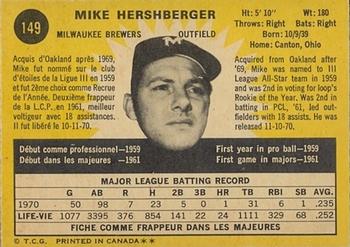
1971 O-Pee-Chee [Back]
By the time he turned 22 years old, Hershberger had already made his major league debut for the White Sox in 1961. He spent four years on Chicago's South Side and, like the remainder of his baseball career, he showed very good contact skills -- striking out in less than 10% of his plate appearances (Hershberger regularly featured in the top 10 most at-bats per strikeout between 1963 and 1967) -- but not much power. Add in the fact that he was not a very successful base stealer (74 of 110 for his career), and you have someone who best fit the role of a fourth outfielder. Still, he had a strong arm and led the AL in assists in 1965, 1966, and 1967.

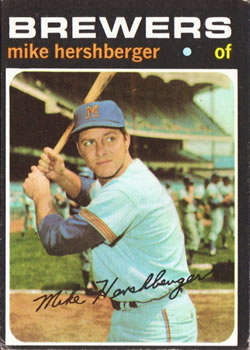
1971 Topps/O-Pee-Chee
His career with the White Sox ended before the 1965 season when he was a part of a big three-team trade. He went to the Kansas City Athletics with Jim Landis and, eventually, Fred Talbot from Chicago. The A's sent Rocky Colavito to Cleveland in the deal. The White Sox sent Cam Carreon to the Indians as well. Cleveland sent Tommie Agee, Tommy John, and John Romano to the White Sox.

His career with Kansas City and, then, Oakland, went well until 1968. In 1968, the A's started forming the base of the team that would become the back-to-back-to-back World Series Champions from 1972 to 1974. The base of the team to which I'm referring is their outfield, comprised of 21-year-old Joe Rudi, 22-year-old Rick Monday, and 22-year-old Reggie Jackson. Of course, that 1968 A's team has a bunch of guys who would later play with Milwaukee/Seattle in the next two-to-three years, so that tells you that they weren't quite ready for primetime yet (that list includes Hershberger, Jim Pagliaroni, Ted Kubiak, Phil Roof, Jim Gosger, Lew Krausse, Jack Aker, Ed Sprague, Diego Segui, Ken Sanders, and George Lauzerique at least).

1970 Flavor-est Milk Set (1986 Reprint)
Hershberger's time in Milwaukee did not last past 1970. Hershberger pulled another groin muscle -- this time on his left side -- near the end of July, causing his season to end after a 1-for-3 performance on July 26. How he pulled the muscle underlines what an unlucky season it was for him: According to the July 29, 1970, Milwaukee Journal, Herschberger was attending a family picnic on an off day after the July 26 game against Boston. The skies opened up, and the family ran for the car. As Hershberger ran for his car, he slipped and pulled the muscle.  In the end, he started just 28 games in 1970, and the team released him after the season. He caught on for one more season in Chicago before retiring.

1994 Miller Commemorative Set
After his baseball career ended, Hershberger ended up in sales in the toy industry. He worked for Hasbro Industries -- the company that gave us the excellent game that killed many folks, "Javelin Darts" or "Jarts" or, simply, lawn darts. Accompanying that nightmare game was another game called The Hypo-Squirt -- described on Wikipedia as "a hypodermic needle shaped water gun tagged by the press as a "junior junkie" kit.

Any of you guys who collect toys own a "Hypo-Squirt"?

Anyway, Hershberger left Hasbro in 1975 and went to work for The Ohio Art Company -- which produced and owned the "Etch A Sketch" toy for over five decades until it sold the product to Spin Master Corp. in January of 2016. 

From there, he moved on to working in sporting good sales for the rest of his life. He spent his spare time working with charities such as the St. Joseph's Orphanage, the Special Olympics, and The Massillon Boys Club, among others. Hershberger passed away at the age of 72 on July 1, 2012. 

Hershberger appears on 8 cards/items as a Brewer (counting the original and the reprint Flavor-Est Milk sets as two separate items). I have the ones I have shown here, and I am missing the 1970 Mike Andersen Postcard (which features the same photo as the Flavor-Est set again...) and the 1970 Milwaukee Brewers Picture Pack of Hershberger.

Have a great day, and thanks for reading.