Showing posts with label George Canale. Show all posts

Tuesday, January 3, 2017

Another Trade Post from Not Another Baseball Card Blog

Before I introduce some cool cards I received from Mike at Not Another Baseball Card Blog, I heard some very sad news today. Hobby legend Bob Lemke passed away today

For those of you who do not know that name, Mr. Lemke was the Editor for the final version of which I am aware of the bible of cards, the 2011 Standard Catalog of Baseball Cards. He also edited the Standard Catalog of Vintage Baseball Cards, which was published in October of 2011 and the Standard Catalog of Minor League Cards, which does not appear to have been updated since It came out in 2000. For many years, he worked for Krausse Publications in Iola, Wisconsin -- the publishers of Sports Collectors Digest and Baseball Cards Magazine -- and his Wisconsin background showed itself regularly in the custom cards he made available through his information-packed blog. His knowledge about all things in our hobby and his proselytizing for the hobby will be missed.

After that somber note, the only appropriate way to respond is to be reverential. Mike from NABCB sent me a number of Canadian cards that I needed for my various team sets and player collections along with some Pacific Legends -- for which I think I now have a complete Milwaukee Braves set.

Let's start with the Pacific Legends


The Pacific Legends set is a concept that I feel like should be brought back by someone other than Topps to highlight the stars of the 1970s and 1980s. I don't trust Topps to do it -- we'd probably end up with 12 variations of Dave Collins and Dale Berra on the Yankees and then one card of Lloyd Moseby to represent the Blue Jays.

But doesn't that sound like a good idea? 

If you look at the list of players who were featured in the original sets, it is a hodgepodge of players from all through baseball history and of varying abilities. It's got everyone from Ty Cobb and Eddie Mathews to Ed Kranepool and Gary Peters. 

I feel like a set of nostalgia like this could do well. I mean, we don't need another set with Paul Molitor and Robin Yount in it, but would you say no if Molitor and Yount and Brett and Gossage were joined by Chris Chambliss, Steve Balboni, Willie Mays Aikens, Lonnie Smith, Vince Coleman, Joe Charbonneau, Mel Hall, Greg Walker, Mickey Rivers, Oddibe McDowell, Jody Davis, Eric Davis, George Bell, Charlie Lea, and Bob Welch?

Archives started out like this, but Topps gave up on that concept quickly and started adding more current players/rookies to drive sales. It's too bad.


Why in the world would I put up two Fleer 1990 cards -- especially a checklist? Because these two cards were the final two Fleer Canadian cards that I needed to complete my team set. I happened across an eBay seller who had two team sets at a reasonable price, so I bought them. It was easier than having to turn over literally every single 1990 Fleer card I ever see to check for "PTD IN CANADA" on the back. Mike happened to have these last two cards that did not come in the team set, and so he sent them to me.

Proving that guys that make the major leagues are special -- especially if they are from a small town -- George Canale was honored in May of 2016 by Cave Spring High School by having his jersey retired. Canale is a Virginia Tech legend, having set the Tech record for career homers (76) and RBI for the Hokies during his three seasons there (1984-1986). Canale retired after the 1999 season and owns a batting cage facility in the Roanoke, Virginia area.


See, here are two guys who should be in that 80s Legends set. Ted Higuera won 20 games in his second season in the majors -- completing 15 games in the process and finishing second in the Cy Yount Award voting behind Roger Clemens's 24-4 season. Funny thing: according to WAR on Baseball-Reference, Higuera was 0.5 wins better than Clemens even though Roger was a unanimous winner.

B.J. Surhoff had a long career in the majors -- 19 years, in fact -- and finished his career with 2326 hits. Perhaps if he had gotten more playing time in Atlanta in 2000-2002 and not been a catcher for much of his early career he would have had a better start offensively and gotten to those major milestones. 
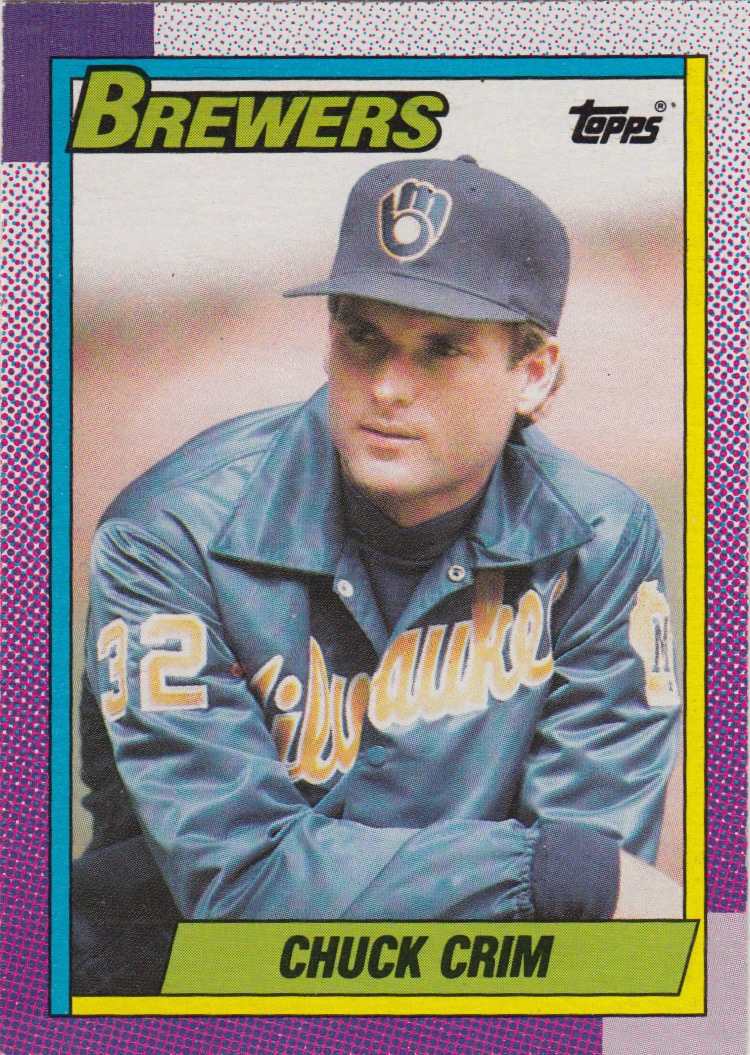


And finally, we have almost certainly the least interesting O-Pee-Chee cards to have ever come out -- the 1990 versions. Keeping the Topps logos on the front and being different only by the occasional "Now With" notation on the front along with the bilingual backs, 1990 O-Pee-Chee really just mailed it in. 

I will say, though, that Jerry Reuss and perhaps Bill Krueger also should have places in that 1980s Legends series I'm advocating for. 

Krueger is an interesting case -- almost certainly he stayed in the major leagues as long as he did because he threw left-handed. He didn't make it to the majors until he was 25, but he stayed until he was 37. In that time, he played for Oakland, the Dodgers, the Brewers, the Mariners, the Twins, Montreal, Detroit, San Diego, and back to Seattle and split his time almost evenly between starting and relieving. He was both more accomplished and more nondescript than I had ever recalled.

And that is saying something.

Perhaps Chris Bosio should be in the 90s Legends version instead. 

Mike, thank you very much for plugging up some gaps in my Canadian baseball card collections -- it is much appreciated. 

Saturday, June 13, 2015

Songs in the Key of Night Owl

Stevie Wonder had his double album called "Songs in the Key of Life" back in 1976. It was critically acclaimed from its release and spoke to many facets of life -- recollections of childhood, first love, lost love, songs about faith, and songs about social justice for the poor. Later acclaim came nearly 30 years after its release in 2005, when Rolling Stone named it number 57 on the list of the 500 greatest albums of all time.

In the blog world, the most critically acclaimed blog around is Night Owl Cards. Greg's writing is excellent and reflects well on his real-world newspaper job. Greg also has consistency and staying power -- he had 329 posts last year, and that was his lowest output since his four-month debut in 2008.  Speaking for myself, I have trouble putting out five posts every week, whether it's because work gets in the way, or my wife says I'm spending too much time with my cards again, or I have a social commitment that I can't get out of (or, even, that I don't want to get out of), or I just don't feel like writing.  

Greg sent me an envelope of cards recently that crossed off several cards off my late 1980s/early 1990s want lists.  To thank him, yes, I'm going with a musically themed post. It's songs in the key of Night Owl!

1.  1990 Baseball Cards Magazine 1968 Topps Design Robin Yount

For whatever reason, I feel like Baseball Cards Magazine did a better job with mimicking the old Topps designs than Topps Archives has lately.  I am not sure if the magazine cards would stand up to the side-by-side scrutiny to which Archives is subjected here, though.

What song goes with this card? How about a Roy Orbison Demo Recording:


2.  1984 Fleer: Moose Haas and Ed Romero


This Moose Haas card shows what to me looks like a guy who was way ahead on fashion trends -- sporting a mullet a full 5 years before the rest of America caught up with him. Haas is remembered as a guy who never seemed to reach his potential, but I choose to remember him as the pitcher who won game 4 of the ALCS in 1982 in snow flurries -- forcing the game 5 that the Brewers won to get to the World Series.

For a guy who played in just 730 games over 12 seasons, Ed Romero certainly enjoyed a great deal of success. He made it to two World Series (1982 & 1986, both losses for his team) and also was a member of the 1988 Red Sox that lost in the ALCS to the Oakland A's.

Success like that enjoyed by these two guys deserves a song off someone's greatest hits album.  How about Little River Band's "The Night Owls"?  Appropriately, this song is from the early 1980s too.


3.  1992 Score


Yet another card I needed for my player collections, the Chuck Crim 1992 Score is now safely in the Crim pages.  Bill Spiers bunting here seems appropriate -- he was drafted in the first round and seemed to have such promise coming out of Clemson.  To be fair to Spiers, he showed the kind of decent player he could be when he was in Houston later in his career -- he had too many injuries in Milwaukee, and the club deemed him expendable.

The less said about Stubbs, the better.  When the best I can say about a guy is that he was a poor man's Greg Brock....

To go along with these cards -- all of which I needed but which by themselves are fairly nondescript -- let's go with an upbeat song from the 1960s by surfer rock king Dick Dale and his Del-Tones called, of course, "Night Owl."


4.  1992 Stadium Club


Though not at all reflective of what is on these cards, I did a "Search Google for this image" for each of these.  The Doug Henry "Best guess for this image" returned, "ken griffey jr autographed" while the Gary Sheffield result was, no lie, "doug mirabelli."

It made me laugh, I guess.

Sort of like the original Blues Brothers movie made me laugh. Perhaps a little known fact is that the Blues Brothers backup band featured three members of the band Booker T & the M.G.'s -- an R&B/funk band which released a hit called "Green Onions" that became a staple for the jazz ensembles at my high school back in the 1980s.  They also had a great tune called "Night Owl Walk."


5.  1987 Donruss Opening Day


This year's Donruss offering used the border design from the 1987 set, but that's where the similarities end.  More to the point, this Opening Day set -- as opposed to Topps's set called Opening Day -- gets it right: Donruss's 1987 set included each team's starting lineup. If Topps did their set this way and didn't use the base set's design -- hell, just use plain white borders, even -- I'd love that set.

This card went right into the Gantner PC for me. Gantner appears to be daring all of us not to admire his auto-tint glasses. 

A song I had never heard before this blog post but which I really liked came from Rock 'N' Roll Hall of Famers The Lovin' Spoonful, and it's called "Night Owl Blues."


6.  1989 Bowman Bill Wegman

It helped complete a team set, so I had to post it.

Not that it has anything to do with my song choice, either.  R&B Legend Wilson Pickett released two of the best "hang out and party and have fun" songs in the 1960s, one of which stands up better, in my opinion, than the other.  The one that doesn't stand up well is "Land of 1000 Dances" -- I mean, any song that's was covered by the WWF Wrestlers int he 1980s.... The one that stands up much better is "Mustang Sally," but I may be biased because I played saxophone.

Wilson Pickett also had a song called "Night Owl" that he released in 1969.


7.  1991 Score 100 Rising Stars


George Canale never sounded to me like he'd be a "rising" star or a star of any kind.  I mean, the former Virginia Tech Hokie told the local newspaper that he wanted a trade in 1991 because the Brewers weren't giving him a chance to play.  Well, George, if you hit .254/.349/.393 in DENVER in 1990 with only 12 home runs in 544 plate appearances, tell my why you deserve a chance?

It also makes me wonder how low the bar for being a "rising star" was.

It's similar to my feelings about Carly Simon as a singer.  I know she was a huge star in the 1970s, but listening to her music then, now, and anywhere in between, I start to wonder whether musical tastes were a bit....off when she hit the top of the charts.  But, she has a greatest hit called "Night Owl" as well.


Greg, thank you very much for the cards, and I hope that at least one of these songs is one you enjoy!