Saturday, April 21, 2018

Blog Bat Around, Part I: The Non-Brewers

I've been incredibly busy this past month away from the blog. I've been working a lot -- getting into the office early and staying late in an effort both to stay on top of my work and in trying to catch up on my billable hours that suffered early in 2018 thanks to Georgia football. Plus, I've been lacking in inspiration again. It happens.

Then, I saw Kenny's idea for a Blog Bat Around: creating an all-autograph lineup from cards in his collection.


The idea is this: build a lineup out of the players from whom you have autographs. Kenny put together a list of 13 total positions to fill -- a Card Gen lineup -- including two relievers, a closer, a starter, a DH/PH, and then the 8 position players. 

I looked at my autographs and realized I could drag this one out into two posts -- one based off non-Brewers (today's post) and one based off Brewers (which hopefully will be tomorrow's post). So, without further introduction, let's get started.

Catcher: Gary Carter, Montreal Expos & New York Mets


In the early 1980s, it was well known among autograph collectors that Gary Carter was one of the good guys who would sign pretty much anything you sent his way. Around 1983 or so, he started asking for a donation for a cancer charity or foundation of some kind in exchange for signing baseball cards issued after that date. I was poor and didn't have a checking account, so I kept loading up on cards from earlier times. In all, I have 18 total cards autographed by Gary Carter.

Honorable Mention: Larry Haney, Johnny Oates, Joe Ferguson, Terry Kennedy, Jim Sundberg, Sal Butera, Lance Parrish, Tim Laudner, Don Slaught, Mike Stanley, Rick Dempsey, Rick Farrell, Geno Petralli, Dwight Lowry

First Base: Steve Garvey, Los Angeles Dodgers


Yeah, it's not the best or most striking autograph you'll find of Garvey. But, it's still mine. I got this one through the mail in the early 1980s as well. Garvey was both a favorite and a villain to me as a kid. He was a good player, no doubt, but he was such an attention seeker. It may seem contradictory to love Gary Carter, whose love of the flashbulbs was well known, but not to like Garvey. I played catcher, though, so Carter was forgiven where Garvey was excoriated.

Honorable Mention: Mike Squires, Terry Francona, Kurt Bevacqua, Andres Galarraga, Darrell Evans, Dave Bergman, Kent Hrbek

Second Base: Lou Whitaker, Detroit Tigers


By the late 1980s, Lou Whitaker had been called a "temperamental" signer. He might sign and return your cards, he might not. He might sign it with just "Lou Whitaker" or with "Louis R. Whitaker" or, as here, "Louis Rodman Whitaker II." Or, you might never see your cards again. So, I guess I got a bit lucky in getting this oddball and a 1987 Topps card back from him in about 1987 or 1988. Whitaker deserves to be in the Hall of Fame, as he was almost certainly the best second baseman in the American League in the 1980s (eclipsed maybe by Ryne Sandberg in the National League).

Honorable Mention: Tom Herr, Steve Sax (probably fake), Jerry Browne, Rex Hudler, Jim Walewander

Shortstop: Alan Trammell, Detroit Tigers


An easy choice with his well-deserved election to the Hall of Fame this year, Trammell was a great guy to get autographs from in the 1980s whether in person or through the mail. This 1987 Topps was an in-person autograph, but I have another 3 or 4 that I got by sending cards to Tiger Stadium. Weirdly, Trammell got into the Hall before Whitaker though Trammell was at best the third-best shortstop in the American League in the 1980s behind Robin Yount and Cal Ripken.

Honorable Mention: Rob Picciolo, Bill Russell, Greg Gagne, Ozzie Guillen

Third Base: Mike Schmidt, Philadelphia Phillies


Despite his fame and the accompanying mail loads that must have produced, Schmidt was always good for signing at least one card in mail sent to him in care of the Phillies. I'm not sure why I sent a 1988 Topps Big card to him to sign, but, well, I must have. 

Honorable Mention: Ron Cey, Bill Madlock, Wade Boggs, Roy Howell, Buddy Bell, Tom Brookens, Tom O'Malley, Tim Wallach, Steve Buechele, Larry Parrish, Doug DeCinces

Left Field: Jim Rice, Boston Red Sox


I had heard bad things about Rice returning mail, so I didn't exactly send him the best-conditioned cards to sign. I'm still not sure if it is real, either. One of the other bad things I heard about Rice was that he employed either an Autopen or a clubhouse man to sign his mail for him. I've posted this autograph on Twitter in the past, and people have told me that it looked good to them. If it is legitimate, it's cool to have another Hall of Fame member.

By the way, for the outfield, I'll do honorable mention at the end.

Center Field: Chet Lemon, Detroit Tigers


The outfield on my autograph team is decent, but it's not awesome. Chet Lemon is a member of the hall of the very good, certainly, but he was never an all-time great. Still, JAWS rates him as the 20th best center fielder of all-time, so he's not *that* bad. He was drafted in the first round in 1972 by Oakland, and was part of a trade in 1975 that sent him to the White Sox for Stan Bahnsen. He was a major league regular with the White Sox at the age of 21 in 1976. The White Sox then traded him to the Tigers after the the 1981 season for Steve Kemp. I got this autograph after a Brewers v. Tigers game in 1987. Looking through my collection, I can say unequivocally that the Tigers of the 1980s were some of the best signers in the American League.

Right Field:  Tom Brunansky, Minnesota Twins


Bruno is undoubtedly the worst player on this team. This spot would have been filled by Tony Oliva, whose autograph I got on a Twins sticker at the same game I got this autograph, but I sent that Oliva autograph away to a Twins collector. Brunansky was known for his rifle arm and his power bat. He was absolutely helped by the Metrodome, which made him into a 30-homer guy on two occasions. The Twins got him from the Angels for Doug Corbett and Rob Wilfong, but then got rid of him in 1988 in exchange for Tom Herr from the Cardinals. The Cardinals traded him to Boston in 1990 for Lee Smith. Boston let him leave for Milwaukee as a free agent after the 1992 season, and the Brewers traded him back to Boston in June of 1994 for Dave Valle. 

Outfield Honorable Mention: Rick Manning, Steve Henderson, Jay Johnstone, Manny Mota, Paul Householder, Bob Clark, Reid Nichols, Gary Matthews, Dusty Baker (probably fake), John Moses, Ron Kittle, Oddibe McDowell, Pat Sheridan, Mike Kingery, Bobby Brower

Designated Hitter/Pinch Hitter: Wade Boggs, Boston Red Sox


He's the best autograph in my collection not playing in the starting lineup, and he was never better than Mike Schmidt. So, Boggs gets put here. If I recall correctly, this one was a TTM. It compares well to autographs from that period, though his later signatures got pointier on the "W" than this one. I think it's good, but I'm not going to get it certified by anyone because I don't care about that.

Honorable Mention: Probably Andres Galarraga.

Starting Pitcher: Bert Blyleven, Pittsburgh Pirates/Cleveland Indians


Like Alan Trammell, Blyleven is another Hall of Famer who was an incredibly fan-friendly guy to fans in the 1980s and who would sign through the mail or in person. I got the Indians one in person, and the Pirates one through the mail. Man, he grew one hell of a beard and mustache between 1981 and 1982, though, didn't he?

Honorable Mention: Don Sutton, Mark Fidrych, Len Barker, Pat Dobson, Dave Goltz, Joe Niekro, Charlie Lea, Danny Darwin, Dave Stieb, Fernando Valenzuela, Storm Davis, John Tudor, Bruce Hurst, Rick Sutcliffe, Frank Viola, Eric King, Frank Tanana, Jose Guzman, John Cerutti, Steve Trout, Ray Peters, Jim Bouton

Right Handed Relief Pitcher: Dan Quisenberry, Kansas City Royals
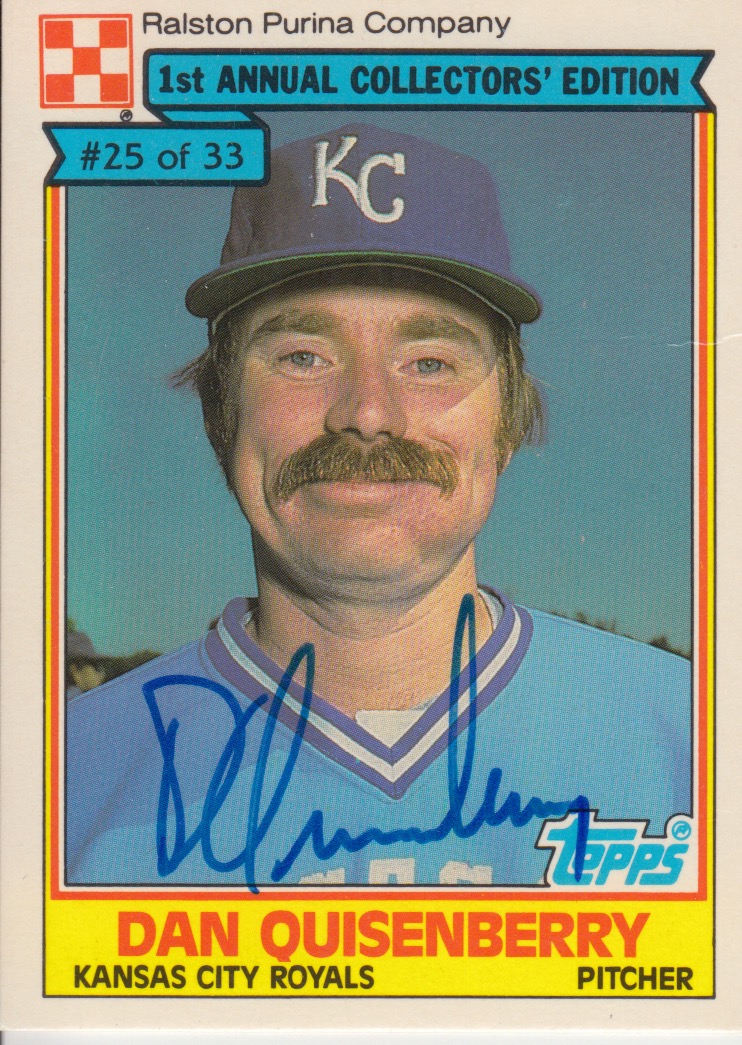

Another of the really good guys in the 1980s. Memories of Quisenberry have faded over the years as closers began piling up crazy save numbers through use in the single-inning role that predominated starting in the late 1980s. Quisenberry did not make it to the majors until age 26 thanks to ditching an over-the-top delivery for an extreme submariner approach. He then led the AL in saves five times, was an all-star three times, finished in the top 5 in the Cy Young Award five times, and finished in the Top 11 for the MVP 5 times. He lost his exclusive closer role in 1986, as Bud Black and Steve Farr ate into his opportunities, and the Royals cut him mid-year in 1988. He had a late career reinvigoration with the Cardinals in 1989, then finished up with 5 nondescript appearances for the Giants in 1990. He died just 8 years later from brain cancer.

Should he be listed at closer? Perhaps. 

Honorable Mention (middle relievers only): Dwight Bernard, Jim Kern, Don Aase, Nate Snell, Pete Ladd, Mark Clear, Tom Tellmann

Left Handed Relief Pitcher: Tug McGraw, New York Mets/Philadelphia Phillies


Sure, the Tugger was more of a closer than middle reliever. But, lefty relievers are tough to find in my collection. I apparently engaged in the type of discrimination common in baseball even up to the 1970s -- viewing relievers as "lesser" pitchers. And I sure was not going to list Steve Howe here. Anyway, McGraw was an excellent TTM signer, so I have many of his cards autographed. 

I wonder if Tim is as good of a signer as his dad was, or if Tug was as good of a singer as Tim is.

Honorable Mention: Rick Waits, Steve Howe

Closer: John Smoltz, Atlanta Braves
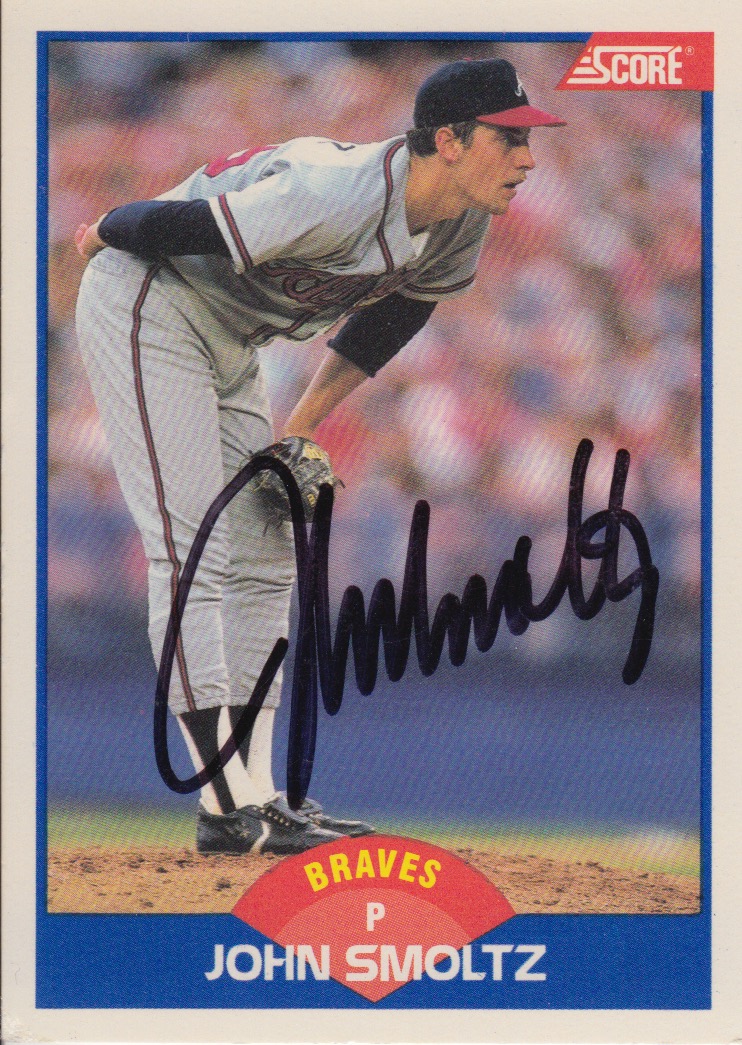

This autograph came in the great Christmas collection haul of 2015. My in-laws bought a collection from a friend whose husband had passed away, and it gave me months of sorting fun and cool finds. None of the finds got much better than finding a John Smoltz autograph on a 1989 Score. 

Honorable Mention (the Closers): Dan Quisenberry, Tug McGraw, Mitch Williams, Jeff Reardon, Steve Bedrosian, Michael Jackson, Doug Jones, Bob Stanley, Jeff Russell

BONUS: Manager: Tom Kelly, Minnesota Twins


I have no recollection of getting this one myself, nor do I recall having found it in that Christmas Collection. I'm thinking my younger brother might have picked it up at some point in the early 1990s at a game in Milwaukee.

But, I chose Kelly here because my other options were Bob "Buck" Rodgers on his 1987 Topps card and Rene Lachemann on his 1982 Donruss card. If you know about Buck's involvement with the Milwaukee organization, you know Buck wasn't a bad manager. Lachemann, on the other hand, never displayed any great skill as a manager -- whether in Seattle (total record of 140-180), Milwaukee (1 year at 67-94), Florida (221-285 from 1993 to 1996) or the Cubs (0-1 in 2002 as interim manager).

Neither are anywhere near as good as Kelly. Also, I was not going to choose any one not listed as a manager or acting as manager at the time of their autograph. So, sorry Terry Francona -- you'll probably get to the Hall as a manager, but not as a player. 

This was fun, definitely. We'll see how the "Brewers only" lineup goes. 

Sunday, March 25, 2018

New Cards from Brent

It's no surprise to anyone who follows me on Twitter or, for that matter, to anyone who reads this blog that I'm less than excited by new card issues. The most excited I got recently was when my pal Ray Peters and my more recent acquaintance Fred Stanley both got cards in the Heritage autographs of the Seattle Pilots. Of course, the initial excitement over those autographs -- and their scarcity -- have made getting any of those from eBay a losing proposition.

In any event, I have been focusing on getting cool 1982-related items. But, in an effort not to fall "behind" the current times, I've signed on with the official BrentandBecca® email list to get my Brewers team sets and an occasional short print.  Let's start with some of the Heritage Brewers regularly printed set.


Yes, believe it or not, the Brewers had TWO members of the Topps 2017 All-Star Rookie team last year. In fairness, there were not too many rookie catchers of any value last year, but Manny Piña was the catcher on the ASR team. 

Also, what is going on with Domingo Santana's photo? That's some messed-up perspective with his hand looking like it's approximately three times the size of the rest of his body, and that bat looks like it's a kid's toy. In fact, it almost looks like his head has been photoshopped into that photo. It just looks weird.


From the short prints, Brent had two of the five Brewers short prints available. I'm wondering when the first set to show Lewis Brinson as a Marlin will be -- and, at the same time, when the first set to show Lorenzo Cain and Christian Yelich will be showing them as Brewers. We have to be getting close, right? I think that Topps's most recent releases are somewhere near early January with catching up with team changes. Perhaps by Allen & Ginter? Or will Yelich & Cain get left out of that set?


When I say, "Topps's most recent releases," I could be talking about the Opening Day set. Despite the fact that Jonathan Villar was absolutely shit last year, Topps is acting like 2017 never happened and are including him in practically every set they put out. 

It's either Villar or Eric Thames, who had a great April last year followed by a so-so rest of the year. The "so-so rest of the year" really came out of the fact that the Brewers had to figure out whether Thames had improved his ability to hit left-handed pitching. He had not, so that led to a platoon with Jesus Aguilar and it is why Thames may be on the bench more frequently this coming year when Ryan Braun gets to play first.

That weird set up is why the two outfielders who played reasonably well last year -- Keon Broxton and Brett Phillips -- were sent down to Colorado Springs this week even though they really do not have anything more to prove in Triple-A. Simply, there just is not enough playing time for Braun, Santana, Yelich, Cain, Thames, and Aguilar if either Broxton or Phillips remained in the majors. Now, injuries and days off will allow those guys to all play enough -- Braun's injuries last year alone would have made that possible. But, when will this logjam of major-league-level outfielders be cleared up? Hopefully a starter will be heading to Milwaukee soon.


And finally, I picked up this 2018 Topps Ryan Braun short print from Brent. I still need a Braun from both the regular set and the Opening Day set for my team collection, and I probably need to pick up another one of those short prints from Heritage for Braun. 

All in all, buying current team sets in this way makes me much happier than trying to get the cards one by one in some fashion. It's easier, it's less expensive, and it limits the amount of time I have to deal with current Topps cards. 

Thanks for stopping by.

Tuesday, March 20, 2018

EA Sports Introduces Zippy Zappy

Back when Zippy Zappy was in elementary school in 2005 and 2006, I was in my 30s and single and happily antisocial. It was a blissful time in 2005 and 2006 -- before social media, after all -- so no one really noticed if I sat home on a Friday night with my dog, a bottle of wine or two, and my PlayStation (and then PlayStation 2) just playing FIFA 2005 and, later, FIFA 2006.

I have to admit that I sort of miss those relatively carefree days. There's a lot more pressure being more "grown up" with a wife and all kinds of other responsibilities. I don't play video games anymore either -- I stopped after the PS3 became obsolete and, well, I stopped when I got married. Playing video games to me was a solo event, and now my solo time is spent with baseball cards.

At any rate, those FIFA games had absolutely brilliant soundtracks. In fact, I found myself going down rabbit trails finding more music by the bands featured on these two games. Since Zippy Zappy likes to share with me what he's been listening to, I thought I'd share some songs that perhaps he's heard and perhaps he has not heard. Oh, and since he sent me cards, that's my excuse for doing it.

Let's start with something that he has a chance of having heard:


Japanese rap trio Soul'd Out starts us off with their bouncy little ditty called "1,000,000 Monsters Attack." It appeared on the FIFA 2005 soundtrack, which was put together by noted British DJ Paul Oakenfold. Oakenfold only included one of his own songs on it, but the soundtrack was very diverse and included songs from artists from nearly 20 countries. This wasn't the only rap song on the soundtrack, but it was the only Japanese song.


It would be poor form if I did not pair the Brewers 2017 first round draft pick with this song since Keston Hiura is a Californian of half Japanese and half Chinese descent. This guy can flat out rake. He got a long look in spring training this year and did well against lesser competition, and he's destined to move quickly up the chain if his defense can keep up with his bat.


When it comes to the music on FIFA 2005, this is the song that got stuck in my head with regularity -- to the point of my buying the album on which it appeared and, then, multiple albums by The Streets. I absolutely love this song, "Fit But You Know It." It's off a concept album called A Grand Don't Come for Free that some people know for the sappy slow song near the end of the album called "Dry Your Eyes" that Mike Skinner (who is The Streets) did with Coldplay lead singer Chris Martin. 


A wonderful song from FIFA 2005 deserves a wonderful football player. Juan Mata is the one Manchester United player that literally everyone in the world loves. Strangely, his name means "John Kills" in Spanish, but he's a true gentleman. He started a charity called Common Goal to which he and nearly 40 other international stars donate 1% of their salaries to a collective fund to support football charities that promote social responsibility. Its members include American women Megan Rapinoe, Alex Morgan, and Heather O'Reilly as well as German defender Mats Hummels, Danish goalkeeper Kasper Schmeichel, Japanese star (and Mata's former Man Utd. teammate) Shinji Kagawa, and Bournemouth defender Charlie Daniels.


Speaking of Manchester United, here's the song that was considered Morrissey's major comeback single in 2004. He had been without a record deal for over seven years when the album You Are the Quarry came out and featured this song and "First of the Gang to Die." That second song was seen as a direct paean to Morrissey's massive following that had built up sort of oddly among the Mexican American community.


Jesus Aguilar is Venezuelan, not Mexican. He's also seemingly a man without a place on the Milwaukee Brewers. Last year, he served well in a semi-platoon role with Eric Thames at 1st base. This year, with the logjam in the outfield, that's more likely to be Ryan Braun's role. The Brewers have to hope that they either can sneak him through waivers or that he can be traded. 

He's also a massive human being -- so massive that Zach Davies and Orlando Arcia can fit in Aguilar's pants together:


Okay then...that's a large man.


Indeed, Japanese rap and English rap were also joined by Brazilian rap from rapper Marcelo D2 with a song called "Profissão M.C." or "Professional M.C." Marcelo is from Rio, and was a member of a band called Planet Hemp. I wonder what it was that they rallied around. The album in 2003 from which this song was drawn was known worldwide for its collaboration with will.i.am from The Black Eyed Peas. But don't hold that against Marcelo.


Speaking of large first basemen, I wonder if Jesus Aguilar could fit into Prince Fielder's pants. They'd probably be a bit short for Aguilar, since Jesus is 3 inches taller and weighs 25 pounds less than big Prince. 


FIFA 2006 brought a different feel to the music. It's less rap, I feel like, and more straight ahead rock, like Bloc Party's "Helicopter." This song was my introduction to Bloc Party, and I ended up buying this album, which had other great songs like "Like Eating Glass" and "Banquet".


I don't think Josh Hader has anything to do with Bloc Party at all that I can discern. I just think that this photo of his Medusa-like hair is pretty awesome and deserved a good song.


LCD Soundsystem got this song on six different games -- FIFA 06, SSX on Tour, Burnout: Revenge, Forza Motorsport 2, and two Dance Dance Revolution games. Critics loved this album. Well, I should say, really, that critics LOVE this band. The types of reviews you get for LCD Soundsystem are fawning and absolutely fall all over themselves to give out plaudits. I think they are a pretty good band, though nowhere near as good as the critics make them out to be.


In the interest of finishing this post today, I am putting up both Tristen Lutz and KJ Harrison. Lutz is still miles and miles away from Miller. I would anticipate that he might play in short-season in Helena again or perhaps move up aggressively to Single-A Wisconsin. I'm just not sure that the Brewers will put him in full-season ball already this year. 

Harrison is a Hawaiian whom the Brewers drafted in the third round out of Oregon State. As with any catching prospect, he may take some time to work his way up to the major leagues. But, we'll see -- perhaps he can move relatively quickly and make the Brewers forget Jacob Nottingham.


Finally, yet another song that convinced me to buy a complete album based off an awesome song on the FIFA 06 soundtrack, this is "Strasbourg" by The Rakes. The Rakes album Capture/Release starts off with this song, and it's actually a bit heavier of a song than much of the rest of the album. I also really like the song "Open Book", and it's worth a listen too.


Caden Lemons was a second round draft pick out of high school from suburban Birmingham (Vestavia Hills High School). The school is a baseball powerhouse which has also produced Chris Hammond, Josh Hancock, and Colter Beam in addition to golfer Smylie Kaufman. Lemons is a 19-year-old pitcher. Remember, TINSTAAPP.

Similar warnings go with Brendan Murphy, who was a fourth round pick out of Mundelein High School near Chicago. Neither one pitched a lot for Milwaukee's farm teams last year. Both might become something in a few years. Murphy had control issues in his 16 innings (12 walks), and Lemons only threw 2-2/3 innings as a professional. 

We'll see if they ever become something. It would be a nice change to have the Brewers produce a star pitcher from their farm system.

My thanks, as always, go out to Kenny. What did y'all think of the music? 


It made me nostalgic.

Saturday, March 17, 2018

Meet the Brewers #41: Dick Ellsworth

On August 7, 1970, the Brewers purchased Dick Ellsworth's contract from the Cleveland Indians. Ellsworth hurried to Kansas City from Cleveland -- where his final two appearances were both walk-off losses over the previous weekend against the Chicago White Sox. Ellsworth arrived in Kansas City in time to give up three earned runs in mop-up time in the second game of a doubleheader. Luckily for Ellsworth's future employment, however, those would be the final runs he allowed all season as he finished the year with the Brewers on a run of 15-1/3 scoreless innings.

1971 Dell Today's Team Stamp, issued in the Brewers team set.
Richard Clark Ellsworth was born in Lusk, Wyoming, in 1940. Thankfully, Ellsworth has a SABR Biography, so I am drawing liberally from that biography. Ellsworth's family moved to Fresno, California, when he was three years old. Ellsworth grew up there and became the ace for a Fresno High School team that featured (including Ellsworth) three noteworthy future major-league players -- including Jim Maloney and Pat Corrales. Other noteworthy Fresno HS alumni include Frank Chance, Dutch Leonard, Tom Seaver, and former Brewer Sean Halton.

Ellsworth was quite heavily pursued for his signature on a contract out of high school. As his SABR biography quotes him, "Before I graduated I received at least one Christmas greeting from a scout on every major league club." Based on getting a cool $60,000 bonus (nearly $521,000 in today's money), he signed up with the Chicago Cubs. The Cubs decided to start him in their annual crosstown charity event against the White Sox, and Ellsworth promptly pitched a complete-game shutout three days out of high school. So, the Cubs kept him on the roster and let him start against the Reds -- who rocked the kid for 4 earned runs in 2-1/3 innings.

The Cubs were pretty hard up for pitching at that point of their existence, so Ellsworth became a rotation fixture just two years later, in 1960. At the age of 22 in 1962, Ellsworth joined a club of dubious membership -- finishing the season with a 9-20 record (and a 5.09 ERA) for a team that was the first in Cubs history to lose 100 games. 

The next year in 1963, however, the team around him was far better, and Ellsworth got both better run support and super lucky on giving up hits (going from over 10 hits per nine innings to 6.9 hits per nine). He finished 22-10 in 290-2/3 innings pitched and, according to WAR, he edged MVP Sandy Koufax out for being the best pitcher in the NL (Willie Mays beat both of them). The team being better mattered because Ellsworth relied on a sinker as his out pitch, and he learned a slider. Offseason rule changes to expand the strike zone also helped.

1971 Topps
That 1963 season led to Ellsworth being an All-Star in 1964 at the age of 24. He did not get to pitch in a game which the NL won by putting up four runs in the bottom of the ninth inning against Boston's closer Dick Radatz. That 1964 Cubs team came into the season with great expectations that were deflated quickly by the off-season death of Ken Hubbs in a plane crash in Utah (as Ellsworth himself said here). Yet, by far, that 1963 season was the pinnacle of Ellsworth's career.  1965 and 1966 saw the Cubs return to the depths of 1962, and Ellsworth's win-loss records reflected that -- 14-15 in 1965 and another 20-loss season in 1966 (finishing with an 8-22 record).

Since in 1960s baseball being a 20-game loser meant you were morally a bad person -- even if, as Willie McCovey said, the players recognized that Ellsworth's win-loss records was "misleading" -- the Cubs traded Ellsworth to the Phillies in December of 1966 in exchange for Ray Culp and cash. He struggled in Philadelphia, and so he found himself traded again after the 1967 season to the Boston Red Sox. Coming off the "Impossible Dream" season, the Red Sox were trying to improve their pitching, and Ellsworth did exactly that. 

Unfortunately, Boston ace (and future Brewer) Jim Lonborg got injured in a ski accident shortly after Ellsworth was acquired, so Ellsworth ended up as the Red Sox Opening Day starter in 1968. Still, a 16-7 record with a 3.03 ERA (well-deserved, with a 3.04 FIP) despite missing several starts in August thanks to contracting the mumps in August was a good return for the Bosox. But, when it came to 1969, Ellsworth chipped his ankle during spring training. The injury -- along with Boston's self-scouting hinting that he'd lost some speed off his fastball -- led Boston to trade him to Cleveland.

1994 Miller Commemorative Set
Looking at Ellsworth's stats may give a little support for the Red Sox view on his fastball. His strikeouts declined from 4.9 K/9 in 1968 down to 3.2 K/9 in 1969. Then, in 1970 with the Indians, Ellsworth was down to just 2.7 K/9 and up to 2.9 BB/9 prior to his sale to Milwaukee. Ellsworth's great results down the stretch in 1970 did not carry over into 1971, however, and Ellsworth made just 11 appearances for the Brewers in 1971 before he was released at the end of June. He never played in professional baseball again.

But, he was not done with baseball. He was very successful in real estate with Grubb & Ellis/Pearson Realty in Fresno and he is still a Senior Vice President with that company's successor company, Newmark Knight Frank. In fact, he was so successful that he purchased an ownership stake in the Triple-A Fresno Grizzlies. He also had the privilege of getting to see his son Steve Ellsworth make 8 appearances in 1988 for the Boston Red Sox. Steve did not have as long or as successful a baseball career as his dad did, though.

I have three of the four baseball cards that the Trading Card Database has Ellsworth listed as a Brewer. The one I am missing -- and which is missing from here -- is Ellsworth's 1971 O-Pee-Chee card #309. 

Thursday, March 15, 2018

Thanks, Jenny

A new-to-me blogger and Twitter card collector is Jenny Miller who blogs at Jenny's Card Collecting. I was excited to get rid of some Twins cards -- even though I'm about 98% sure I'll be attended a Twins/Brewers game at Target Field in May, that doesn't mean I have to keep Twins cards around the house, you know. I knocked off a bunch of Jenny's Twins Project needs from the late 1970s and early 1980s.

In return, Jenny sent me a couple of cards that I needed for my collection. It being a Thursday night I figured I'd go for musical accompaniment. Then again, I might say that about any day. I just like musical accompaniment. Believe it or not (I know, you believe it), I actually put a spreadsheet together of all the songs I've used on my blog. I'm up to 806 right now (before this post)! Crazy.

Anyway, let's see what Jenny sent:


Yes, it's a Maverick from 2018 Topps. With the logjam in the outfield brought about by the off-season trades, Mav will probably end up at Triple A unless the team keeps him over Broxton as the guy who can fill in at CF behind both Cain and Yelich. Then again, since both Cain and Yelich can play center and with Braun, Thames, and Santana all still available, why would the team keep either Broxton or Phillips in the major leagues? Tough situation.


I unwittingly told two or three people that I needed only Brett Phillips to finish out my Series 1 Topps run for 2018. Thing is, I still need a Ryan Braun because I spaced out and forgot I need two of those. So, I duplicated Phillips just like I'm duplicating this song. I know I've played Cowboy Mouth's "Jenny Says" before -- my spreadsheet tells me so -- but I like the song, the band is from New Orleans, and I'm going to New Orleans next month. So there.


Speaking of needing two Brauns for my base sets, here's a 2017 Stadium Club that I needed. This one was, in fact, for my team set as the second of the Brauns from that year. It's always good to get closer and closer to completing team sets.

This reminds me to say two things about team sets and how I'm collecting. First, I will gladly take any and all inserts and parallels of non-player-collection Brewers that you want to send my way. But, I'm not as militant about feeling like I need to collect those going forward from sets from this year forward. 

Second, I am also happy to take any and all Brewers cards of any genre, year, or make that you might want to send to me. That may seem intuitive, but there were times I really was not a huge fan of all the duplicates. Now, though, I'm saying bring 'em on. Of course I prefer cards I don't have -- but I'll take the others too.


I shouldn't use a song using the past tense about Jenny so soon -- I know that. But I really like this song off Hot Fuss by The Killers. As much as Brandon Flowers comes across as a self-important ass at times, the band's first major label album was one of the best albums of the mid-2000s in my opinion. It didn't hurt that I was in a major Brit Pop phase and this album worships at the altar of New Order, The Cure, and Depeche Mode.


Finally, Jenny sent me a Zach Davies 2017 Stadium Club card. Zach is an interesting guy. He looks like he should be delivering the morning paper on his bike like it's 1984 until you see his tattoos all over the inside of his left arm. Nothing wrong with that at all -- but it adds a little edge to him as a result. Davies benefited from good run support last year, and his strikeout rates were troubling for his future growth. Then again, he's only 24 years old so perhaps that will come in the next couple of years.


Let's close this out with a little Mitch Ryder & The Detroit Wheels. They are almost certainly known best for their cover of the Motown song "Devil with a Blue Dress On." This song, "Jenny Take a Ride," was the band's first top 10 hit, selling over a million copies and going gold. 

But...there's one more song that needs to be played...it's a cliche at this point, but so what:


Jenny, thanks for the cards. Hope we can trade again soon.